
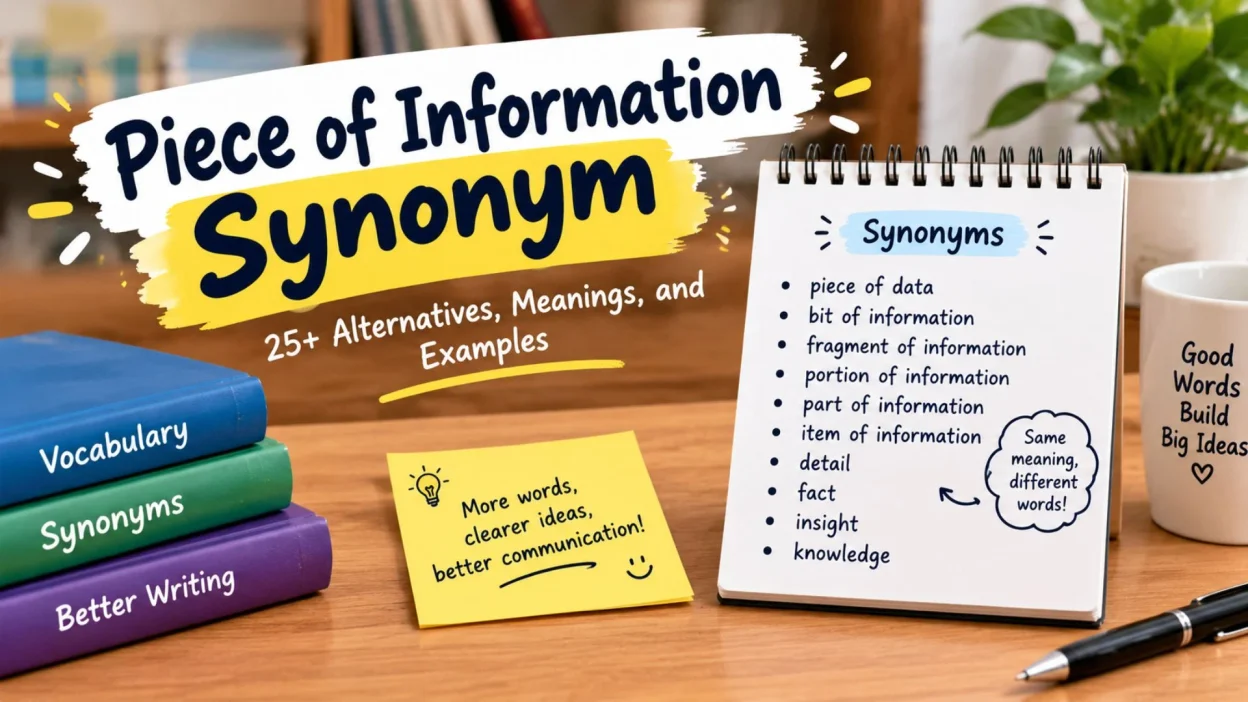
Finding the right piece of information synonym can help you make your writing clearer, more natural, and more engaging. Whether you’re writing an academic paper, preparing a business report, or improving your everyday vocabulary, choosing the right alternative can make a meaningful difference. Words and phrases such as detail, fact, data, information, insight, and piece of knowledge can all replace “piece of information” in certain situations.
However, not every synonym has exactly the same meaning. For example, a fact refers to something known to be true, while a detail describes a specific part of a larger subject. Similarly, data often refers to collected information, whereas an insight offers a deeper understanding of something.
In this guide, you’ll discover useful synonyms for piece of information, their meanings, and practical examples. You’ll also learn which alternatives work best in formal writing, casual conversations, academic assignments, and professional communication.
📚 Best Synonyms for Piece of Information
The phrase “piece of information” refers to a single item, fact, or detail that provides knowledge about a particular subject.
These alternatives are useful when you want to avoid repetition while keeping your meaning clear.
- Detail — A specific part of a subject or situation.
- Fact — Something known or proven to be true.
- Data — Information collected for analysis or reference.
- Item — A single piece within a collection.
- Point — A particular idea or piece of information.
- Insight — Information that provides deeper understanding.
- Tidbit — A small, interesting piece of information.
- Finding — Information discovered through research or investigation.
- Record — Information stored for future reference.
- Observation — Information noticed through careful examination.
- Note — A short piece of written information.
- Statement — A declaration that communicates information.
- Clue — Information that helps solve a problem or mystery.
- Evidence — Information that supports a claim or conclusion.
- Report — An organized presentation of information.
- Knowledge — Information or understanding gained through experience or learning.
- Datum — A single unit of data.
- Specification — A precise detail about something.
- Disclosure — Information revealed or made known.
- Intelligence — Information gathered for decision-making or investigation.
✍️ Piece of Information Synonyms for Formal Writing
Formal writing often requires precise vocabulary and a professional tone.
The following alternatives are particularly useful in reports, research papers, business documents, and academic assignments.
- Fact — The report includes a significant fact about consumer behavior.
- Detail — The proposal contains an important detail about the project timeline.
- Data — The researchers collected data from several participants.
- Finding — The study presented an important finding about workplace productivity.
- Evidence — The investigation revealed evidence of a significant change.
- Observation — The scientist recorded an observation during the experiment.
- Statement — The document includes a statement regarding the company’s policy.
- Record — The database contains a record of every transaction.
- Specification — The contract includes a specification for the required materials.
- Disclosure — The company issued a disclosure about its financial position.
- Documentation — The application requires documentation of previous experience.
- Insight — The analysis provides insight into customer preferences.
- Reference — The report includes a reference to the original research.
- Account — The witness provided an account of the incident.
- Conclusion — The research supports a conclusion about the observed results.
- Statistic — The presentation includes a statistic about employment rates.
- Measurement — The experiment produced a measurement of the temperature.
- Assessment — The review contains an assessment of the project’s progress.
- Result — The experiment produced a result that challenged the original theory.
- Interpretation — The article offers an interpretation of the available evidence.
💬 Piece of Information Synonyms for Everyday Conversations
In casual conversations, simple and familiar words usually sound more natural than formal expressions.
These alternatives help you communicate clearly without making your sentences sound overly complicated.
- Thing — I learned an interesting thing about the human brain.
- Fact — Here’s a fun fact about space.
- Detail — Can you share one more detail about the event?
- Tidbit — She told me a fascinating tidbit about history.
- Bit — I heard a bit of information about the new restaurant.
- Point — That’s an interesting point about the situation.
- Piece of news — I have a surprising piece of news for you.
- Update — Can you give me an update about the meeting?
- Tip — He shared a useful tip for improving my writing.
- Clue — That clue helped us understand what happened.
- Insight — Your insight helped me see things differently.
- Message — I received a message about the schedule.
- Note — She left a note with some helpful information.
- Reminder — Here’s a quick reminder about tomorrow’s appointment.
- Suggestion — He offered a suggestion that made the task easier.
- Idea — That’s an interesting idea worth discussing.
- Advice — My teacher gave me some useful advice.
- Explanation — Her explanation helped me understand the problem.
- Discovery — We made an exciting discovery during the trip.
- Word — I heard a word about the upcoming changes.
🎓 Academic Synonyms for Piece of Information
Academic writing benefits from words that describe information according to its purpose and source.
Choosing a precise alternative helps readers understand whether you’re discussing evidence, research, data, or an interpretation.
- Research finding — The research finding supports the proposed hypothesis.
- Empirical evidence — Empirical evidence strengthens the study’s argument.
- Dataset — The dataset contains responses from 500 participants.
- Observation — The observation suggests a possible relationship between the variables.
- Research result — The research result provides additional context.
- Statistical datum — Each statistical datum contributes to the overall analysis.
- Reference point — The historical figure serves as a reference point.
- Evidence-based insight — The evidence-based insight informs future research.
- Analytical finding — The analytical finding reveals a meaningful pattern.
- Documented fact — The documented fact supports the author’s claim.
- Research evidence — The research evidence indicates a possible improvement.
- Primary data — The primary data came directly from the participants.
- Secondary data — The secondary data was obtained from published reports.
- Research observation — The research observation was recorded during testing.
- Scientific finding — The scientific finding contributes to existing knowledge.
- Measured result — The measured result was compared with the expected value.
- Experimental evidence — The experimental evidence supports the conclusion.
- Study outcome — The study outcome provides useful information for policymakers.
- Research insight — The research insight highlights an important relationship.
- Supporting detail — The supporting detail clarifies the central argument.
🧠 Difference Between Piece of Information and Its Synonyms
Although many words can replace “piece of information,” their meanings are not always identical.
Understanding these differences helps you select an alternative that fits your sentence.
| Synonym | Meaning | Best Use |
|---|---|---|
| Fact | Something true or established | Factual statements |
| Detail | A specific part of something | Descriptions |
| Data | Information collected for analysis | Research and statistics |
| Insight | A deeper understanding | Analysis and interpretation |
| Finding | Something discovered | Research and investigations |
| Tidbit | A small, interesting fact | Casual conversation |
| Evidence | Information supporting a claim | Arguments and reports |
| Clue | Information that helps solve something | Mysteries and investigations |
| Record | Stored information | Databases and documentation |
| Observation | Something noticed or examined | Research and everyday situations |
When Should You Use “Fact”?
Use “fact” when the information is known to be true or can be verified.
Example: “The fact that water freezes at 0°C under standard atmospheric pressure is widely established.”
When Should You Use “Detail”?
Use “detail” when referring to a specific part of a larger subject.
Example: “The final report includes an important detail about the project’s budget.”
When Should You Use “Data”?
Use “data” when discussing collected information, particularly in research, statistics, or technical contexts.
Example: “The team analyzed the data to identify patterns in customer behavior.”
When Should You Use “Insight”?
Use “insight” when the information provides a deeper understanding of a topic.
Example: “The interview offered valuable insight into the customer’s experience.”
When Should You Use “Finding”?
Use “finding” when information has been discovered through research, investigation, or analysis.
Example: “The latest finding suggests that the treatment may improve performance.”
📝 Examples of Piece of Information in Sentences
The phrase “piece of information” can be used in many different contexts.
These examples show how to replace it with a more specific synonym while keeping the original meaning.
– Original: I received a useful piece of information about the interview.
Alternative: I received a useful tip about the interview.
– Original: The report contains one important piece of information.
– Original: She shared an interesting piece of information about animals.
Alternative: She shared an interesting fact about animals.
– Original: We need another piece of information before making a decision.
Alternative: We need additional data before making a decision.
– Original: The document provides a useful piece of information.
Alternative: The document provides a valuable insight.
– Original: The detective found a piece of information about the suspect.
Alternative: The detective discovered a clue about the suspect.
– Original: The presentation included a piece of information about sales.
Alternative: The presentation included a statistic about sales.
– Original: He gave me a piece of information that changed my opinion.
Alternative: He shared an insight that changed my opinion.
– Original: The database stores every piece of information.
Alternative: The database stores every record.
– Original: The article contains an important piece of information.
Alternative: The article contains an important fact.
– Original: The scientist recorded a piece of information during the experiment.
Alternative: The scientist recorded an observation during the experiment.
– Original: The teacher gave us a piece of information about the exam.
– Original: The report presented a piece of information supporting the claim.
Alternative: The report presented evidence supporting the claim.
– Original: I found a piece of information that helped me solve the problem.
Alternative: I found a clue that helped me solve the problem.
– Original: The study provided a piece of information about the participants.
Alternative: The study provided a research finding about the participants.
🔍 Related Phrases and Alternatives
Sometimes, replacing the entire phrase “piece of information” with another expression makes your sentence sound more natural.
These related phrases offer additional choices for different writing situations.
- A piece of knowledge — A small amount of knowledge about a subject.
- A source of information — Something that provides information.
- A bit of information — A small amount of information.
- A wealth of information — A large amount of useful information.
- A valuable insight — Information that provides meaningful understanding.
- A useful detail — A specific and helpful piece of information.
- An important fact — A fact that matters in a particular context.
- A relevant point — Information connected to the subject.
- A key finding — An important discovery from research.
- A helpful clue — Information that assists in solving a problem.
- A data point — One individual value in a dataset.
- A valuable observation — A meaningful observation about a situation.
- A noteworthy detail — A detail worth paying attention to.
- A new discovery — Information found for the first time.
- A research insight — Understanding gained through research.
- A factual statement — A statement based on facts.
- An informative note — A short note containing useful information.
- A relevant fact — A fact related to the subject.
- A useful reference — A source or item used for information.
- A significant finding — An important result of an investigation.
❓ Frequently Asked Questions About Piece of Information Synonyms
Choosing the right synonym depends on your sentence, audience, and writing style.
These frequently asked questions explain how to use alternatives correctly.
What Is Another Word for Piece of Information?
Some common synonyms for “piece of information” include detail, fact, data, insight, finding, point, item, and tidbit. The best choice depends on the context.
What Is a Single Piece of Information Called?
A single piece of information may be called a fact, detail, item, or datum. In a research context, “datum” refers to one individual unit of data.
What Is a Formal Synonym for Piece of Information?
Formal alternatives include fact, detail, finding, observation, evidence, data, and statement. These words are commonly used in academic writing, professional reports, and research documents.
What Is a Casual Synonym for Piece of Information?
Casual alternatives include tidbit, bit, fact, thing, tip, and detail. For example, “She shared an interesting tidbit about history” sounds natural in everyday conversation.
Is “Detail” a Synonym for Piece of Information?
Yes. “Detail” is a common synonym for “piece of information,” especially when referring to a specific part of a subject or situation.
Example: “The report includes an important detail about the project.”
Is “Data” the Same as a Piece of Information?
Data refers to information collected for analysis or reference. A single unit of data is called a datum, while a dataset contains multiple data points.
What Is the Difference Between Information and Insight?
Information provides facts or knowledge about a subject. Insight goes further by offering a deeper understanding of that information and its meaning.
How Can I Avoid Repeating “Piece of Information”?
Use alternatives such as fact, detail, finding, insight, observation, or data. However, choose words based on their meaning rather than simply replacing every occurrence with a different synonym.
🎯 Conclusion
Finding the right piece of information synonym can improve your vocabulary and make your writing more precise. Words such as fact, detail, data, insight, finding, and observation offer useful alternatives in different contexts.
For casual conversations, expressions like “tidbit,” “bit,” and “tip” often sound natural. Meanwhile, academic and professional writing may benefit from more precise terms such as “evidence,” “research finding,” “datum,” or “observation.”
The key is to understand the meaning behind each word before using it as a replacement. A fact is not always the same as an insight, and data does not always mean a single detail.
By choosing the right alternative, you can avoid repetition, improve clarity, and communicate your ideas more effectively.