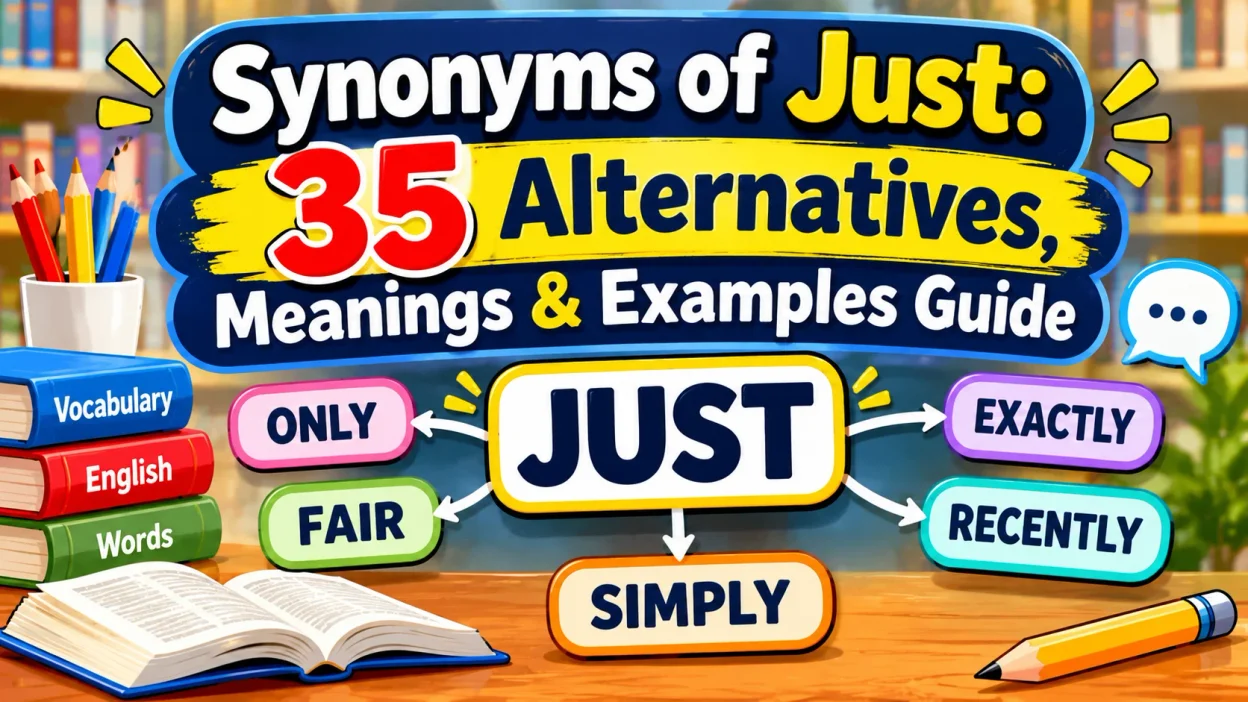
Finding the right synonyms of just can make your writing clearer, more precise, and less repetitive. The word just has several meanings depending on how it appears in a sentence. It can mean fair or morally right, but it can also mean only, simply, exactly, or very recently. Because of these different uses, choosing a suitable replacement requires understanding the context rather than swapping words randomly.
For example, only may replace just in “I just need one minute,” while fair works in “a just decision.” Similarly, exactly can fit when just emphasizes precision, as in “That’s just what I wanted.”
This guide explores 35 alternatives to just, explains their meanings, and provides example sentences. You’ll also learn which replacements work in formal writing, everyday conversation, academic work, and professional communication.
📖 What Does Just Mean?
The word just is commonly used as an adverb or adjective. Its meaning changes according to the sentence, which is why it has so many possible synonyms.
As an adverb, just can mean only, simply, exactly, recently, or barely. For instance, “I just arrived” means that the person arrived a short time ago. However, “I just need a pen” means that a pen is the only thing required.
As an adjective, just usually means fair, reasonable, or morally right. For example, “The judge made a just decision” describes a decision based on fairness and justice.
Here are the main meanings to remember:
- Only or merely: Something is limited in amount or importance.
- Exactly: Something matches what is needed or expected.
- Recently: An action happened a short time ago.
- Barely: Something happened by a very small margin.
- Fair or righteous: A decision or action follows principles of justice.
- Simply: Something is straightforward or uncomplicated.
Understanding these meanings will help you select a replacement that preserves the original message.
🔤 35 Synonyms of Just With Meanings and Examples
The following alternatives cover the most common meanings of just. Some are close replacements, while others work only in particular contexts. Always check the sentence before choosing one.
🌟 Synonyms Meaning Only or Merely
When just means that something is limited or nothing more than what is mentioned, these alternatives are often useful.
- 1. Only — Means no more than or nothing except something. Example: I only need five minutes to finish the task.
- 2. Merely — Refers to something that is simply or no more than what is stated. Example: It was merely a suggestion, not a formal instruction.
- 3. Simply — Means only or just, often with a sense of simplicity. Example: I simply wanted to help you.
- 4. Solely — Means exclusively or for one particular reason or purpose. Example: The decision was based solely on the available evidence.
- 5. Exclusively — Means limited to one person, group, purpose, or thing. Example: This room is exclusively for registered members.
- 6. Purely — Means entirely or only, without another factor. Example: Her decision was purely personal.
- 7. Nothing but — Means only or no more than something. Example: It was nothing but a misunderstanding.
⚖️ Synonyms Meaning Fair, Right, or Righteous
When just describes fairness, morality, or equal treatment, use words that communicate justice rather than limitation.
- 8. Fair — Treats people reasonably and without favoritism. Example: Everyone deserves a fair opportunity.
- 9. Equitable — Fair and impartial, especially when considering different needs or circumstances. Example: The organization introduced an equitable hiring policy.
- 10. Impartial — Not favoring one side over another. Example: A judge must remain impartial throughout the hearing.
- 11. Unbiased — Free from personal opinions or unfair preferences. Example: We need an unbiased review of the proposal.
- 12. Righteous — Morally good or morally correct. Example: She believed she was defending a righteous cause.
- 13. Upright — Honest and morally principled. Example: He was respected as an upright community leader.
- 14. Ethical — Consistent with accepted principles of right conduct. Example: The company made an ethical choice.
- 15. Legitimate — Lawful, valid, or justified according to accepted rules. Example: The residents had a legitimate concern about the new policy.
🎯 Synonyms Meaning Exactly or Precisely
Sometimes just emphasizes that something is correct, accurate, or perfectly suited to a situation. These alternatives can make the meaning more specific.
- 16. Exactly — Means completely correct or accurate. Example: That’s exactly what I wanted to hear.
- 17. Precisely — Means with complete accuracy or exactness. Example: The meeting began precisely at noon.
- 18. Specifically — Refers to one particular thing rather than something general. Example: I specifically asked for the updated report.
- 19. Directly — Means without an unnecessary step or interruption. Example: The message relates directly to your question.
- 20. Right — Can mean exactly or immediately in informal expressions. Example: The store is right around the corner.
- 21. Dead-on — Informally means completely accurate. Example: Your prediction was dead-on.
⏰ Synonyms Meaning Recently or A Short Time Ago
In sentences about time, just often indicates that an action happened very recently. These alternatives help make the timing clearer.
- 22. Recently — Means not long ago. Example: I recently started a new job.
- 23. Lately — Refers to the recent period, often including repeated or ongoing experiences. Example: I’ve been reading more lately.
- 24. A moment ago — Means a very short time before now. Example: She called me a moment ago.
- 25. A short while ago — Refers to something that happened recently. Example: We received the announcement a short while ago.
- 26. Freshly — Means recently or newly, often describing something prepared, made, or completed. Example: The freshly painted room looks brighter.
📏 Synonyms Meaning Barely or Almost Not
When just suggests a narrow margin or the smallest possible amount, these expressions can communicate that meaning more clearly.
- 27. Barely — Means only just or by a very small amount. Example: We barely caught the last train.
- 28. Scarcely — Means almost not or only by a small degree. Example: There was scarcely enough food for everyone.
- 29. Hardly — Means almost not or only to a limited extent. Example: I could hardly hear the announcement.
- 30. By a hair — An informal expression meaning by a very small margin. Example: Our team won by a hair.
- 31. Narrowly — Means by only a small difference or margin. Example: The candidate narrowly won the election.
✨ Synonyms Meaning Simply or In a Straightforward Way
In some sentences, just adds emphasis to a simple action or request. These alternatives can make the wording more natural.
- 32. Plainly — Means clearly or in a simple manner. Example: She plainly explained the problem.
- 33. Easily — Means without difficulty or complication. Example: You can easily solve this problem with practice.
- 34. Straightforwardly — Means directly and without unnecessary complexity. Example: He straightforwardly explained why the plan would not work.
- 35. Frankly — Means honestly or openly, often when expressing a personal view. Example: Frankly, I expected a better result.
📝 Best Synonyms of Just for Different Contexts
Not every synonym can replace just in every sentence. For accurate writing, identify what the word means first. The following examples show how to select a suitable alternative in common situations.
When Just Means Only
Use only, merely, solely, or simply when you want to express a limitation.
| Original sentence | Better alternative |
|---|---|
| I just want some water. | I only want some water. |
| It was just a joke. | It was merely a joke. |
| She just works on weekends. | She works exclusively on weekends. |
| I just wanted to ask a question. | I simply wanted to ask a question. |
In everyday writing, only is usually the most natural replacement. Meanwhile, solely and exclusively sound more formal and emphasize that there are no other purposes or options.
When Just Means Fair
Use fair, equitable, impartial, or unbiased when discussing justice, decisions, treatment, and rules.
| Original sentence | Better alternative |
|---|---|
| The judge made a just decision. | The judge made a fair decision. |
| Everyone deserves a just opportunity. | Everyone deserves an equitable opportunity. |
| We need a just evaluation. | We need an impartial evaluation. |
| The process should be just. | The process should be unbiased. |
For formal discussions about equality, equitable may be more precise than fair. However, impartial is especially useful when describing someone who must consider different sides without favoritism.
When Just Means Exactly
Use exactly or precisely when emphasizing accuracy or a perfect match.
| Original sentence | Better alternative |
|---|---|
| That’s just what I needed. | That’s exactly what I needed. |
| The train arrived just at noon. | The train arrived precisely at noon. |
| This is just the place I wanted. | This is exactly the place I wanted. |
These alternatives are useful in professional emails, instructions, reports, and everyday conversations.
When Just Means Recently
Use recently, a moment ago, or a short while ago when describing an action that happened shortly before the present.
| Original sentence | Better alternative |
|---|---|
| I just finished my work. | I recently finished my work. |
| She just called me. | She called me a moment ago. |
| We just received the news. | We received the news a short while ago. |
Keep in mind that recently can refer to a broader period than just. If an event happened seconds ago, a moment ago may communicate the timing more accurately.
🎓 Formal and Academic Synonyms of Just
In academic and professional writing, repeating just can make sentences sound informal or imprecise. Replacing it with a more specific term can improve clarity. However, the best replacement depends on the intended meaning.
| Meaning of just | Formal alternative | Example |
|---|---|---|
| Only | Solely | The results were based solely on verified data. |
| Only | Exclusively | Access is exclusively available to staff. |
| Fair | Equitable | The policy promotes equitable treatment. |
| Fair | Impartial | The panel conducted an impartial review. |
| Exactly | Precisely | The measurements were recorded precisely. |
| Recently | Recently | The research was recently published. |
| Simply | Merely | The statement was merely an observation. |
| Clearly | Plainly | The findings plainly demonstrate the difference. |
Alternatives for Academic Essays
When writing an essay, avoid replacing every occurrence of just with a more complicated word. Instead, choose language that communicates your argument accurately.
For example:
- Instead of “The study just examines one group,” write “The study examines only one group.”
- Instead of “The policy is just,” write “The policy is equitable.”
- Instead of “The evidence just supports the claim,” write “The evidence directly supports the claim.”
- Instead of “The researcher just recently published the paper,” write “The researcher recently published the paper.”
The goal is not to make every sentence sound formal. Rather, it is to remove ambiguity and make your writing easier to understand.
💬 Casual and Everyday Alternatives to Just
In conversations, just often makes a sentence sound relaxed or less demanding. You can use simple alternatives without making your speech overly formal.
Consider these examples:
- “I only need a minute” instead of “I just need a minute.”
- “I simply forgot” instead of “I just forgot.”
- “I barely made it” instead of “I just made it,” when you mean you succeeded by a very small margin.
- “I recently moved here” instead of “I just moved here.”
- “That’s exactly right” instead of “That’s just right,” when you mean completely correct.
However, be careful with expressions that have different meanings. For instance, just right means perfectly suitable, while exactly right generally means completely correct. They overlap in some situations, but they are not interchangeable everywhere.
🔍 Just vs. Its Most Common Synonyms
Some alternatives look similar but have different shades of meaning. Understanding these differences helps prevent awkward sentences.
Just vs. Only
Both words can express limitation. However, only is usually clearer when referring to one person, item, or possibility.
- Just: I just need one more chance.
- Only: I only need one more chance.
Both sentences communicate a similar idea. In many contexts, the difference is mainly one of emphasis and tone.
Just vs. Merely
Merely often makes something sound less important or less significant. It is more formal than just.
- Just: It was just an idea.
- Merely: It was merely an idea.
The second sentence may suggest that the idea should not be treated as something more substantial.
Just vs. Fair
These words are related when just describes morality or justice. However, fair is often more conversational, while just can sound more formal or ethical.
- Just: The decision was just.
- Fair: The decision was fair.
Both suggest that the decision was reasonable and free from unfair treatment.
Just vs. Exactly
When just means a perfect match, exactly can make the meaning more direct.
- Just: That’s just what I meant.
- Exactly: That’s exactly what I meant.
The second version emphasizes accuracy more strongly.
Just vs. Recently
These words can describe events that happened not long ago. Nevertheless, recently may cover a longer period.
- Just: I just arrived.
- Recently: I recently arrived.
The first often suggests that the arrival happened moments ago. The second can refer to any time within a broader recent period.
✍️ Example Sentences Using Synonyms of Just
Seeing alternatives in complete sentences makes their meanings easier to understand. Here are additional examples showing how different synonyms work naturally in everyday and professional writing.
- Only: We only have two tickets available.
- Merely: His comment was merely an observation.
- Simply: She simply asked for an explanation.
- Solely: The project depends solely on community support.
- Exclusively: The service is exclusively available online.
- Purely: Their disagreement was purely professional.
- Fair: The teacher gave every student a fair chance.
- Equitable: The organization wants an equitable distribution of resources.
- Impartial: The committee promised an impartial investigation.
- Unbiased: An unbiased report should consider all the evidence.
- Righteous: They believed they were supporting a righteous cause.
- Upright: The community admired her upright character.
- Ethical: The business followed ethical practices.
- Legitimate: The customer raised a legitimate complaint.
- Exactly: You described the situation exactly.
- Precisely: The package arrived precisely when expected.
- Specifically: He specifically requested a written response.
- Directly: The new rule directly affects the department.
- Right: The pharmacy is right across the street.
- Dead-on: Her estimate was dead-on.
- Recently: We recently changed our website design.
- Lately: He has been working late lately.
- A moment ago: I saw your message a moment ago.
- A short while ago: The meeting ended a short while ago.
- Freshly: They served freshly baked bread.
- Barely: She barely passed the final examination.
- Scarcely: We had scarcely enough time to prepare.
- Hardly: I could hardly believe the announcement.
- By a hair: The runner won by a hair.
- Narrowly: The proposal narrowly passed the vote.
- Plainly: The instructions plainly explain the process.
- Easily: You can easily find the information online.
- Straightforwardly: The manager straightforwardly addressed the issue.
- Frankly: Frankly, the original plan needs improvement.
⚠️ Common Mistakes When Using Synonyms of Just
Although many words can replace just, choosing the wrong one can change the meaning of a sentence. Watch out for these common mistakes.
- Using fair instead of only: “I fair need a minute” is incorrect. Use “I only need a minute.”
- Using recently instead of exactly: “That’s recently what I wanted” does not make sense. Use “That’s exactly what I wanted.”
- Using merely when emphasis is important: Merely can minimize the importance of something, so it may not preserve the original tone.
- Confusing barely with only: Barely suggests a small amount or narrow margin, while only indicates limitation.
- Using righteous for ordinary fairness: Righteous often carries a strong moral or religious tone. For everyday decisions, fair or impartial may be more suitable.
- Replacing every use with simply: Simply does not express every meaning of just, particularly when the word refers to recent timing or fairness.
A useful writing habit is to read the complete sentence after making a substitution. If the meaning changes, choose another word.
FAQs About Synonyms of Just
What is the most common synonym of just?
The most common synonym depends on the sentence. Only is a frequent replacement when just means nothing more than something. However, fair works when it describes justice, while exactly works when it emphasizes accuracy.
What is another word for just in a sentence?
Possible alternatives include only, simply, merely, exactly, precisely, and fair. For example, “I just need help” can become “I only need help.” Choose the replacement according to the intended meaning.
What is a formal synonym for just?
Formal alternatives include solely, exclusively, equitable, impartial, precisely, and legitimate. The best choice depends on whether just means only, fair, or exactly.
What is a synonym for just meaning fair?
When just means fair or morally right, suitable synonyms include fair, equitable, impartial, unbiased, righteous, and ethical. These words are especially useful when discussing decisions, rules, treatment, and justice.
What is a synonym for just meaning only?
The closest alternatives are only, merely, simply, solely, and exclusively. For example, “I just need one answer” can be rewritten as “I only need one answer.”
What is another word for just in academic writing?
In academic writing, you can use solely, exclusively, precisely, impartially, or equitable, depending on the context. Avoid choosing a complex word merely to sound formal; clarity should always come first.
Can just mean recently?
Yes. As an adverb, just can indicate that something happened a short time ago. For example, “I just finished the assignment” means the assignment was completed recently. You can also use recently or a moment ago, depending on the timing.
Are just and only interchangeable?
They are interchangeable in many sentences when both mean no more than something. However, just has additional meanings, including fair, exactly, and recently. Therefore, only cannot replace it in every context.
What is the difference between just and merely?
Both can mean only, but merely often emphasizes that something is not important or is less significant than it may appear. Just is more flexible and common in everyday conversation.
How can I avoid repeating the word just?
First, identify what just means in each sentence. Then select a suitable alternative, such as only, exactly, recently, or fair. You can also restructure the sentence to make it clearer instead of forcing a synonym into every occurrence.
Conclusion
The best synonyms of just depend on the meaning you want to communicate. When the word means only, alternatives such as merely, simply, and solely can work well. When it describes fairness, consider equitable, impartial, or unbiased. Meanwhile, exactly and precisely are useful when you want to express accuracy, while recently helps describe something that happened a short time ago.
Understanding these differences will help you write with greater clarity and avoid unnecessary repetition. Instead of replacing just with the first similar word you find, consider the full sentence and choose the alternative that preserves its meaning. That way, your vocabulary becomes more varied without making your writing sound unnatural.