Introduction
The word skills appears everywhere, from job applications and resumes to school assignments and everyday conversations. However, repeating the same word can make your writing sound ordinary. Choosing a more precise synonym helps you explain exactly what someone can do, what they have learned, and where their strengths lie.
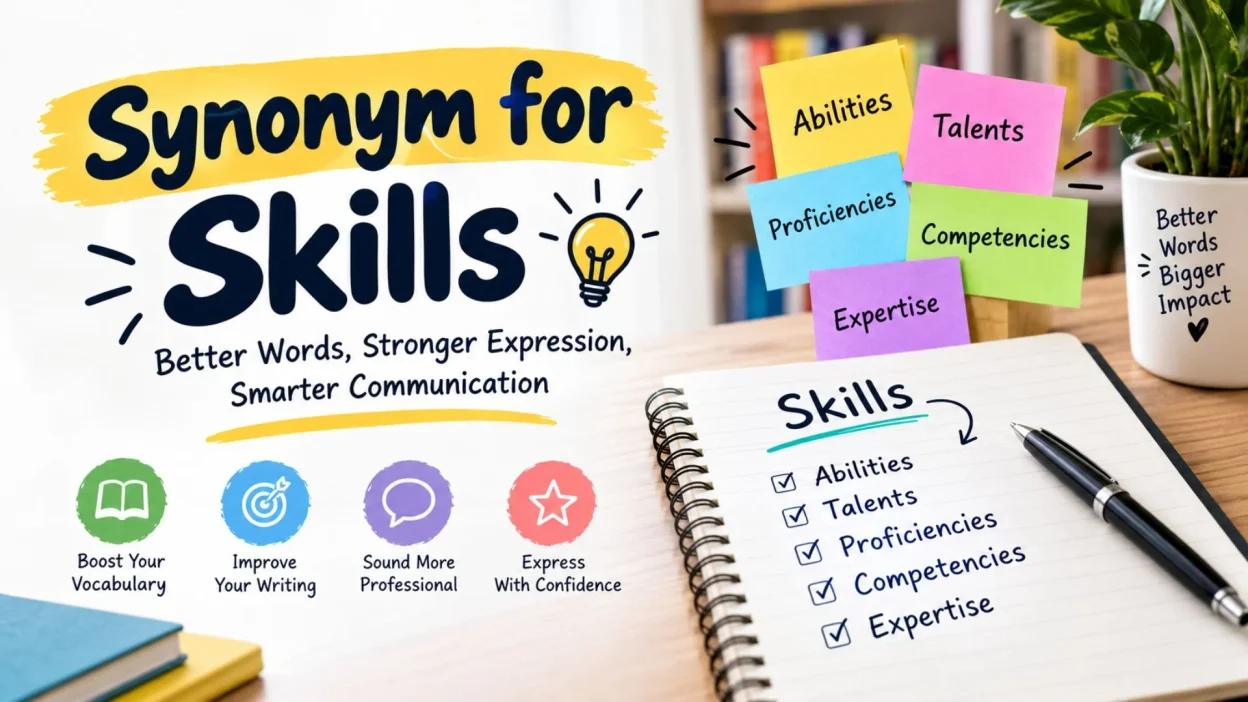
A synonym for skills can be abilities, competencies, expertise, talents, proficiencies, or capabilities. Although these words share similar meanings, they are not always interchangeable. For example, expertise suggests advanced knowledge, while talents often refers to natural strengths.
The best alternative depends on your purpose. A resume may benefit from words such as competencies and proficiencies, whereas a casual conversation may sound more natural with abilities or strengths.
In this guide, you will discover 25 useful synonyms for skills, understand their meanings, explore example sentences, and learn which alternatives work best in professional, academic, and everyday writing.
🔤 25 Synonyms for Skills With Meanings
Not every synonym communicates the same level of experience.
Use this list to choose a word that matches the person’s abilities and the message you want to convey.
🧠 1. Abilities
Abilities is one of the most versatile synonyms for skills. It describes what someone can do, whether the ability comes from natural aptitude, practice, education, or experience.
Example: Her communication abilities help her explain complicated ideas clearly.
Best used for: General writing, conversations, biographies, and professional descriptions.
💼 2. Competencies
Competencies refers to the combination of knowledge, practical skills, and behaviors needed to perform a particular role effectively.
Example: The position requires strong leadership and problem-solving competencies.
Best used for: Resumes, job descriptions, performance reviews, and workplace assessments.
🎓 3. Expertise
Expertise describes advanced knowledge or considerable experience in a specific subject or activity.
Example: His expertise in digital marketing helped the company improve its online visibility.
Best used for: Professional profiles, specialist roles, consulting, and technical fields.
🌟 4. Talents
Talents generally refers to natural aptitudes or abilities that allow someone to perform certain activities particularly well.
Example: She has a talent for explaining difficult subjects in simple language.
Best used for: Creative writing, personal introductions, informal descriptions, and discussions of natural strengths.
📈 5. Proficiencies
Proficiencies describes the degree to which someone can perform a task or use a particular tool, language, or system competently.
Example: The candidate listed her software proficiencies on the application.
Best used for: Resumes, language abilities, software knowledge, and technical qualifications.
🛠️ 6. Capabilities
Capabilities emphasizes what a person or organization is able to accomplish.
Example: The training program expanded employees’ technical capabilities.
Best used for: Business writing, project planning, professional development, and performance descriptions.
💪 7. Strengths
Strengths highlights areas where someone performs well or has a particular advantage.
Example: Teamwork and clear communication are two of his greatest strengths.
Best used for: Interviews, self-assessments, biographies, and personal development.
📖 8. Know-How
Know-how means practical knowledge of how to complete a task or solve a problem.
Example: Her technical know-how made the equipment installation much easier.
Best used for: Informal business writing, practical experience, technical work, and hands-on tasks.
🧩 9. Aptitudes
Aptitudes refers to a natural ability or an inclination to learn or perform a particular activity.
Example: The assessment identified his aptitude for mathematics.
Best used for: Career guidance, education, recruitment, and discussions about potential.
🏆 10. Proficiencies and Competences
Competences is an alternative spelling and form of competencies in some varieties of English and professional contexts. It describes the abilities needed to perform a task effectively.
Example: The training course evaluates the professional competences required for the role.
Best used for: Formal writing, educational standards, and professional assessments.
⚙️ 11. Technical Abilities
Technical abilities describes the practical or specialized tasks someone can perform using particular tools, systems, or methods.
Example: The employer is looking for technical abilities in database management.
Best used for: Engineering, IT, manufacturing, research, and other technical professions.
🤝 12. Interpersonal Abilities
Interpersonal abilities are the abilities used to communicate, cooperate, and build effective relationships with other people.
Example: Strong interpersonal abilities help managers resolve disagreements constructively.
Best used for: Leadership, customer service, teamwork, healthcare, and people-focused roles.
🗣️ 13. Communication Abilities
Communication abilities describe how effectively someone shares information, listens, explains ideas, and adapts messages to an audience.
Example: Clear communication abilities are important when presenting a project to clients.
Best used for: Resumes, presentations, interviews, teaching, and customer-facing positions.
🧠 14. Problem-Solving Abilities
Problem-solving abilities refer to identifying challenges, evaluating possible solutions, and choosing an effective course of action.
Example: Her problem-solving abilities helped the team meet a difficult deadline.
Best used for: Management, technical work, research, education, and project-based roles.
🎨 15. Creative Abilities
Creative abilities describe the capacity to develop original ideas, explore possibilities, or create something new.
Example: The designer’s creative abilities brought a fresh perspective to the campaign.
Best used for: Design, writing, marketing, art, product development, and innovation.
📋 16. Qualifications
Qualifications refers to credentials, education, training, or experience that make someone suitable for a particular role.
Example: Her qualifications include a degree in accounting and several relevant certifications.
Best used for: Job applications, recruitment, professional profiles, and academic opportunities.
Important distinction: Qualifications are not always direct synonyms for skills. A qualification may demonstrate that someone has learned a subject, but it does not automatically prove mastery of every related task.
🔍 17. Mastery
Mastery describes a high level of understanding or control over a subject, technique, or activity.
Example: Years of practice gave him mastery of the instrument.
Best used for: Advanced learning, specialist knowledge, creative disciplines, and technical achievements.
🚀 18. Proficiency Levels
Proficiency levels describes how well someone can perform a task, often using categories such as beginner, intermediate, and advanced.
Example: The application asks candidates to indicate their proficiency levels in different languages.
Best used for: Language assessments, software lists, employee evaluations, and training records.
Important distinction: This phrase describes the degree of ability rather than providing a direct one-word replacement for skills.
🏅 19. Accomplishments
Accomplishments refers to achievements resulting from effort, ability, or experience.
Example: Her accomplishments demonstrate how effectively she manages complex projects.
Best used for: Resumes, portfolios, performance reviews, and professional biographies.
Important distinction: An accomplishment is a result, not the ability itself. It can provide evidence of a skill.
🧰 20. Practical Abilities
Practical abilities refers to the capacity to apply knowledge in real situations rather than simply understanding a concept.
Example: The course develops practical abilities in budgeting and financial planning.
Best used for: Vocational education, hands-on work, technical training, and everyday problem-solving.
📊 21. Professional Competencies
Professional competencies describes the combination of abilities, knowledge, and behaviors required in a particular profession.
Example: The program helps graduates develop professional competencies for the workplace.
Best used for: Career development, workplace training, job descriptions, and professional education.
🌱 22. Aptitudes and Strengths
Aptitudes and strengths is a phrase that combines natural potential with areas where a person already performs well.
Example: The career counselor helped students identify their aptitudes and strengths.
Best used for: Career planning, student guidance, coaching, and self-assessment.
Important distinction: Aptitude often emphasizes potential, while strength emphasizes an existing advantage.
🧑💻 23. Technical Proficiency
Technical proficiency describes the ability to use specialized tools, technologies, methods, or systems competently.
Example: The role requires technical proficiency in spreadsheet software and data analysis.
Best used for: IT resumes, technical applications, engineering profiles, and software-related roles.
🎯 24. Functional Abilities
Functional abilities describes what someone can do within a particular role, task, or practical situation.
Example: The assessment measures the functional abilities needed to operate the equipment safely.
Best used for: Workplace assessments, task analysis, training, and role-specific documentation.
✨ 25. Specialties
Specialties refers to particular subjects, services, or areas in which someone has concentrated knowledge or experience.
Example: Content strategy and keyword research are two of her specialties.
Best used for: Professional bios, service descriptions, portfolios, and business profiles.
Important distinction: A specialty is an area of focus rather than a direct synonym for every skill someone possesses.
💼 Best Synonyms for Skills on a Resume
A resume should communicate your abilities clearly and connect them to the position you want.
Rather than replacing every occurrence of skills, choose words that accurately describe your experience and professional strengths.
Here are some useful alternatives for different resume situations:
💼 Competencies: Job-related abilities that combine knowledge with effective performance.
🎯 Core competencies: A concise way to showcase your strongest professional skills.
📈 Technical proficiencies: Highlights your knowledge of software, programming languages, tools, and technical systems.
🧠 Areas of expertise: Emphasizes fields where you have substantial knowledge or experience.
🤝 Professional strengths: Covers qualities such as leadership, teamwork, communication, and organization.
🛠️ Practical experience: Focuses on hands-on work rather than theoretical knowledge.
📋 Qualifications: Includes relevant education, certifications, and professional credentials.
Examples of Resume Wording
Instead of writing, “I have excellent skills in project management,” you could write:
- Project management expertise: Coordinated projects, schedules, and team responsibilities.
- Core competencies: Planning, organization, stakeholder communication, and risk management.
- Technical proficiencies: Experienced with relevant project management and reporting tools.
- Key achievements: Successfully delivered projects while meeting agreed deadlines.
Choose the wording that reflects your actual experience. Strong terminology helps readers understand your contribution, but specific evidence makes your resume more convincing.
🎓 Synonyms for Skills in Academic Writing
Academic writing often requires precise language.
The best alternative depends on whether you are discussing a student’s ability, a learned technique, or demonstrated competence.
Useful Academic Alternatives
- Abilities: General capacity to complete academic tasks.
- Competencies: Knowledge and abilities required to meet learning objectives.
- Proficiencies: Demonstrated competence in a subject or activity.
- Aptitudes: Potential to learn or perform a particular task.
- Research capabilities: Abilities related to gathering, evaluating, and interpreting information.
- Analytical abilities: Capacity to examine information and identify relationships.
- Writing proficiency: Ability to communicate ideas effectively in written form.
- Practical competencies: Ability to apply classroom learning to real situations.
Academic Example Sentences
Original: The course helps students improve their skills.
Alternative: The course helps students develop their academic competencies.
Original: She has strong writing skills.
Alternative: She demonstrates a high level of writing proficiency.
Original: The assessment measures students’ skills in mathematics.
Alternative: The assessment evaluates students’ mathematical abilities.
The important point is accuracy. Use aptitude when discussing potential, proficiency when emphasizing demonstrated ability, and competency when referring to the requirements for successful performance.
🔄 Skills vs. Abilities vs. Competencies vs. Expertise
These words are related, but their meanings differ in useful ways.
Understanding the distinctions helps you choose the most accurate term for your sentence.
| Word | Main Meaning | Example |
|---|---|---|
| Skills | Learned or developed ability to perform tasks | Her writing skills are improving. |
| Abilities | General capacity to do something | He has strong analytical abilities. |
| Competencies | Knowledge, skills, and behaviors needed for effective performance | Leadership is one of the role’s core competencies. |
| Expertise | Advanced knowledge or experience in a subject | She has expertise in cybersecurity. |
| Talents | Natural aptitude or particular ability | He has a talent for music. |
| Proficiencies | Demonstrated competence in an activity | The form lists language proficiencies. |
| Capabilities | Capacity to perform or achieve something | The new system expands the team’s capabilities. |
| Strengths | Areas of particular advantage | Organization is one of her strengths. |
| Aptitudes | Potential or inclination to learn or perform something | He has an aptitude for science. |
| Qualifications | Credentials, training, education, or experience relevant to a role | The job requires specific qualifications. |
Which Word Should You Choose?
Use skills when discussing specific tasks a person can perform, such as editing, coding, or operating machinery.
Choose abilities for a broader description of what someone can do. Use competencies when the context involves professional standards or successful performance in a role.
Reserve expertise for advanced knowledge or substantial experience. Meanwhile, talent and aptitude are useful when natural strengths or potential are central to your point.
✍️ How to Use a Synonym for Skills in a Sentence
Choosing an alternative is only the first step.
You also need to make sure the word fits the grammar, tone, and meaning of your sentence.
Professional Examples
- Skills → Competencies: The employee demonstrated strong leadership competencies.
- Skills → Expertise: Her expertise in content strategy helped improve the campaign.
- Skills → Proficiencies: The applicant listed her software proficiencies.
- Skills → Capabilities: The training strengthened the team’s technical capabilities.
- Skills → Strengths: Problem-solving is one of his greatest strengths.
Personal Examples
- Skills → Abilities: His artistic abilities developed through regular practice.
- Skills → Talents: She has a natural talent for storytelling.
- Skills → Aptitudes: The program helps learners identify their aptitudes.
- Skills → Know-how: Practical know-how made the repair possible.
- Skills → Gifts: He has a gift for encouraging others.
Avoid These Common Mistakes
Do not use a formal synonym just to sound impressive. A simple word such as abilities may be clearer than competencies in a casual sentence.
Do not confuse a result with an ability. Completing a successful project is an accomplishment; managing the project is a skill.
Do not claim expertise without supporting experience. Expertise suggests advanced knowledge, so use it when your background justifies the description.
Check singular and plural forms. You can say “a skill,” “several skills,” “an ability,” or “multiple competencies.” However, “expertise” is generally an uncountable noun when referring to knowledge in a field.
❓ Frequently Asked Questions About Synonyms for Skills
What is the best synonym for skills?
Abilities is one of the closest general alternatives because it describes what someone can do. However, competencies, expertise, and proficiencies may be more appropriate in professional contexts.
What is a professional word for skills?
Competencies is a common professional alternative, especially in job descriptions and performance reviews. You can also use expertise for advanced knowledge or proficiencies for demonstrated competence in specific tasks.
What is another word for skills on a resume?
Useful resume alternatives include core competencies, technical proficiencies, areas of expertise, and professional strengths. Select the term that best represents the abilities you want an employer to notice.
What is a synonym for skills and abilities?
Capabilities can describe the general capacity to perform tasks or achieve results. Depending on the context, competencies and proficiencies can also work.
What is the difference between skills and talents?
Skills are often developed through learning, practice, and experience. Talents generally refer to natural aptitudes, although talent can also improve with training and effort.
Is expertise the same as skills?
Not exactly. Skills describe abilities to perform tasks, while expertise usually implies advanced knowledge or substantial experience in a particular area.
What is the opposite of skills?
There is no single opposite that fits every context. Depending on the sentence, you might use inability, inexperience, or lack of proficiency to describe the absence of a particular ability.
How can I avoid repeating the word skills?
Replace repeated instances with precise alternatives such as abilities, strengths, competencies, or expertise. You can also rewrite the sentence to describe the actual task or achievement instead of using another synonym.
🎯 Conclusion: Choose the Right Synonym for Skills
The best synonym for skills depends on what you want to communicate. Abilities is a versatile everyday alternative, competencies works well in professional settings, and expertise highlights advanced knowledge or experience.
For resumes, consider terms such as core competencies, technical proficiencies, and areas of expertise. In casual conversations, talents, strengths, and know-how often sound more natural.
Ultimately, the strongest word is the one that expresses your meaning accurately. Instead of choosing a complicated alternative simply to make your writing sound impressive, select a word that helps your reader understand exactly what you can do.