
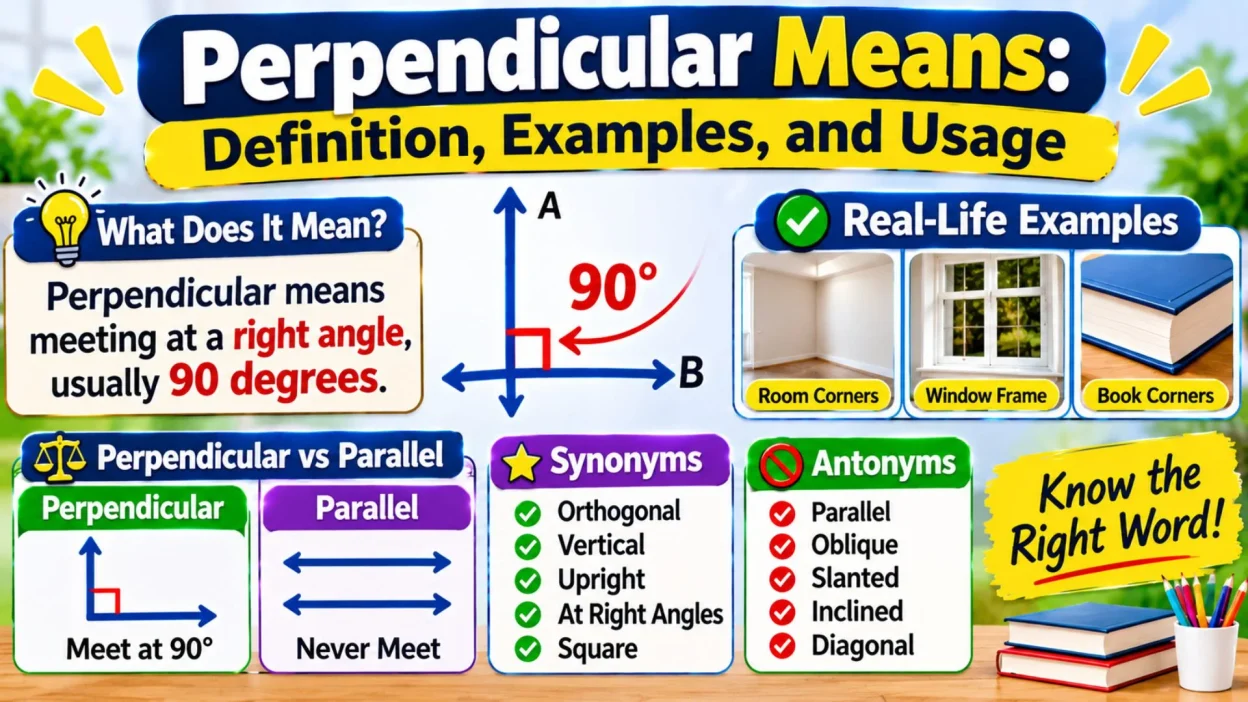
What does perpendicular means refer to in mathematics and everyday English? The word perpendicular describes two lines, surfaces, or objects that meet at a right angle. A right angle measures exactly 90 degrees. For example, the corner of a square, the meeting point of two walls, and the lines forming the letter T can all show this relationship.
Understanding this term is especially useful in geometry, construction, architecture, and technical drawing. Moreover, it helps you describe the position of objects accurately. In this guide, you will learn its definition, explore simple examples, understand related words, and see how to use it correctly in sentences.
📚 What Does Perpendicular Mean?
In geometry, perpendicular describes two lines that intersect at an angle of exactly 90 degrees. Their intersection creates four equal right angles.
The symbol used to represent this relationship is ⊥. For example, if line AB meets line CD at a right angle, you can write:
AB ⊥ CD
This symbol indicates that the two lines meet at a 90-degree angle.
The word can also describe objects or surfaces positioned at right angles to one another. For instance, a vertical wall and a horizontal floor form this relationship when they meet at a square corner.
📏 What Is a Perpendicular Line?
A perpendicular line intersects another line at a 90-degree angle. Both lines create four right angles at their intersection.
<AsyncImage query=”educational geometry diagram two perpendicular lines intersecting at 90 degrees with clear right angle square marker labeled” aspectRatio=”16:9″ width=”100%” />
For example, imagine drawing one horizontal line across a piece of paper. Next, draw a vertical line that crosses it at a right angle. These two lines are perpendicular.
Important features include:
- They intersect at exactly 90 degrees.
- They form four right angles.
- Their intersection creates a square corner.
- They appear in geometric shapes and everyday structures.
- In a coordinate plane, two non-vertical lines have perpendicular slopes when their slopes are negative reciprocals.
However, two lines that simply cross are not necessarily perpendicular. Their intersection must form a right angle.
🏠 Everyday Examples of Right Angles
You can find these relationships in many familiar objects. Looking around your home or classroom makes the concept easier to understand.
🚪 A Door and Its Frame
The horizontal top of a rectangular door frame meets its vertical sides at right angles. Therefore, these edges form a perpendicular relationship.
This example is easy to recognize because standard door frames usually have square corners. However, decorative or curved designs may look different.
📖 The Corners of a Book
A typical rectangular book has four corners. Each corner forms a 90-degree angle between two adjoining edges.
Consequently, those edges meet at right angles.
🧱 Two Meeting Walls
In a room with a rectangular layout, two adjoining walls often meet at a right angle. This creates the same geometric relationship.
The concept is also important when designing rooms, buildings, and furniture.
🪟 Window Frames
Many rectangular window frames have horizontal and vertical edges. Where these edges meet, they form right angles.
This makes a window frame another useful example of geometric intersections.
✏️ The Letter T
The letter T provides a simple visual example. Its horizontal top crosses its vertical stem at a 90-degree angle in a standard geometric drawing.
This is one of the easiest ways to remember the concept.
📐 Perpendicular vs. Parallel Lines
These two terms describe different relationships between lines. Understanding the difference helps prevent confusion in geometry.
<AsyncImage query=”educational geometry comparison parallel lines and perpendicular lines side by side labeled parallel and perpendicular 90 degrees” aspectRatio=”16:9″ width=”100%”/>
| Feature | Perpendicular Lines | Parallel Lines |
|---|---|---|
| Meaning | Meet at 90 degrees | Remain the same distance apart |
| Intersection | They intersect | They do not intersect |
| Angle | Exactly 90 degrees | No intersection angle |
| Symbol | ⊥ | ∥ |
| Example | Adjacent edges of a square | Opposite edges of a rectangle |
What Are Parallel Lines?
Parallel lines are lines in the same plane that remain the same distance apart and never meet, even when extended indefinitely.
For example, the opposite edges of a rectangular ruler are parallel.
What Makes These Lines Different?
The main difference is simple. Perpendicular lines meet at a right angle, while parallel lines remain separate.
Therefore, check whether two lines intersect before deciding which term describes them.
🔤 Synonyms and Related Words
Several words have meanings related to perpendicular. However, not every alternative has exactly the same mathematical meaning.
| Word | Meaning |
|---|---|
| Orthogonal | At right angles, especially in mathematics |
| Vertical | Directed up and down |
| Upright | Standing straight or vertically |
| At right angles | Meeting at 90 degrees |
| Square | Forming a right angle in a particular context |
| Transverse | Crossing or extending across something |
| Intersecting | Meeting or crossing at a point |
Orthogonal is the closest technical alternative in many mathematical contexts. Meanwhile, vertical and upright describe orientation, not necessarily a 90-degree relationship between two lines.
↔️ Antonyms and Contrasting Terms
There is no single perfect antonym for this geometric term in every situation. However, several words describe contrasting positions or relationships.
- Parallel: Lines that do not intersect in the same plane.
- Oblique: Positioned at an angle other than 90 degrees.
- Slanted: Inclined or tilted away from a vertical or horizontal position.
- Inclined: Set at an angle rather than standing upright.
- Diagonal: Extending between corners or across a shape.
For example, two parallel lines never meet, while perpendicular lines intersect at 90 degrees. Similarly, oblique lines can cross at an angle other than a right angle.
✍️ Example Sentences Using Perpendicular
Reading complete sentences helps you understand how to use the word naturally.
- The two lines are perpendicular to each other.
- A vertical wall meets the floor at a perpendicular angle.
- The teacher drew two perpendicular lines on the board.
- The sides of a square meet at right angles.
- The carpenter checked whether the edges were perpendicular.
- The road runs perpendicular to the main street.
- The diagram shows two perpendicular directions.
- The horizontal and vertical lines form a right-angle intersection.
- The architect used perpendicular measurements when planning the room.
- The students learned how to identify right angles.
Notice that the word can describe lines, directions, edges, and surfaces. Its central meaning remains the same: a 90-degree relationship.
🧮 How to Identify Perpendicular Lines in Geometry
You can identify these lines by checking the angle where they intersect. There are several simple ways to do this.
Look for a 90-Degree Angle
First, examine the point where the two lines meet. If they form a right angle, they satisfy the geometric definition.
A small square marker inside the angle often indicates 90 degrees in geometry diagrams.
Use a Protractor
A protractor can help you measure the angle between two intersecting lines.
Place its center at the intersection point. Then align its baseline with one line and check where the other line crosses the scale.
If the angle measures exactly 90 degrees, the lines meet at right angles.
Check Their Slopes
In coordinate geometry, two non-vertical lines with defined slopes are perpendicular when their slopes are negative reciprocals.
For example:
- First line slope: 2
- Second line slope: -1/2
Multiplying the slopes gives -1. Therefore, the two lines are perpendicular.
Vertical and horizontal lines also form right angles, although the slope rule is handled separately because a vertical line has an undefined slope.
FAQ Section
What Does Perpendicular Mean in Simple Words?
It describes two lines or objects that meet at a 90-degree angle. For example, the corner of a square shows this relationship.
Does Perpendicular Mean 90 Degrees?
Yes. In geometry, intersecting perpendicular lines form four angles of exactly 90 degrees.
What Is the Symbol for Perpendicular?
The symbol is ⊥. It indicates that two lines or geometric objects meet at right angles.
What Is the Difference Between Perpendicular and Parallel?
Perpendicular lines intersect at 90 degrees. In contrast, parallel lines remain the same distance apart and never intersect in the same plane.
What Is Another Word for Perpendicular?
Orthogonal is a common mathematical alternative. The phrase at right angles also explains its meaning clearly.
Can Perpendicular Lines Be Vertical and Horizontal?
Yes. A vertical line and a horizontal line are perpendicular when they intersect because they form a 90-degree angle.
Conclusion
Understanding perpendicular means can make geometry and everyday measurements easier. The term describes two lines, surfaces, or objects that meet at exactly 90 degrees. Common examples include the corners of books, square frames, adjoining walls, and the letter T.
Moreover, knowing the difference between perpendicular and parallel lines helps you identify geometric relationships correctly. Remember the symbol ⊥ and its key rule: intersecting lines must form a right angle. Explore more vocabulary guides on SynonymNexa to improve your English and mathematical vocabulary.