Looking for another word for this? The best alternative depends on what you want to say and the context of your sentence. The word “this” is commonly used to point to something nearby, introduce an idea, or refer to a situation that someone has mentioned. However, repeating it too often can make your writing sound vague or repetitive.
Fortunately, several words and phrases can replace “this” in the right situation. For example, you might use “that,” “it,” “the following,” “the present,” or a more specific noun. Each option has a slightly different meaning, so choosing the right one matters.
In this guide, you will discover useful synonyms for “this,” learn when to use them, and explore practical examples. Additionally, you will find alternatives for formal writing, everyday conversation, academic work, and professional communication.
What Does “This” Mean?
“This” is a demonstrative word used to identify a particular person, thing, idea, or situation. It usually refers to something close to the speaker or something currently being discussed.
For example, you might say, “This book is interesting.” Here, “this” identifies a specific book. Similarly, in the sentence “This is an important decision,” the word points to a particular decision or situation.
The word “this” can perform different grammatical roles.
- As a determiner: This house belongs to my uncle.
- As a pronoun: This is exactly what I wanted.
- When introducing information: This is how the process works.
- When referring to a situation: This makes the problem more complicated.
Therefore, the best synonym depends on how “this” functions in your sentence. A word that works in one example might sound unnatural in another.
Best Synonyms for “This”
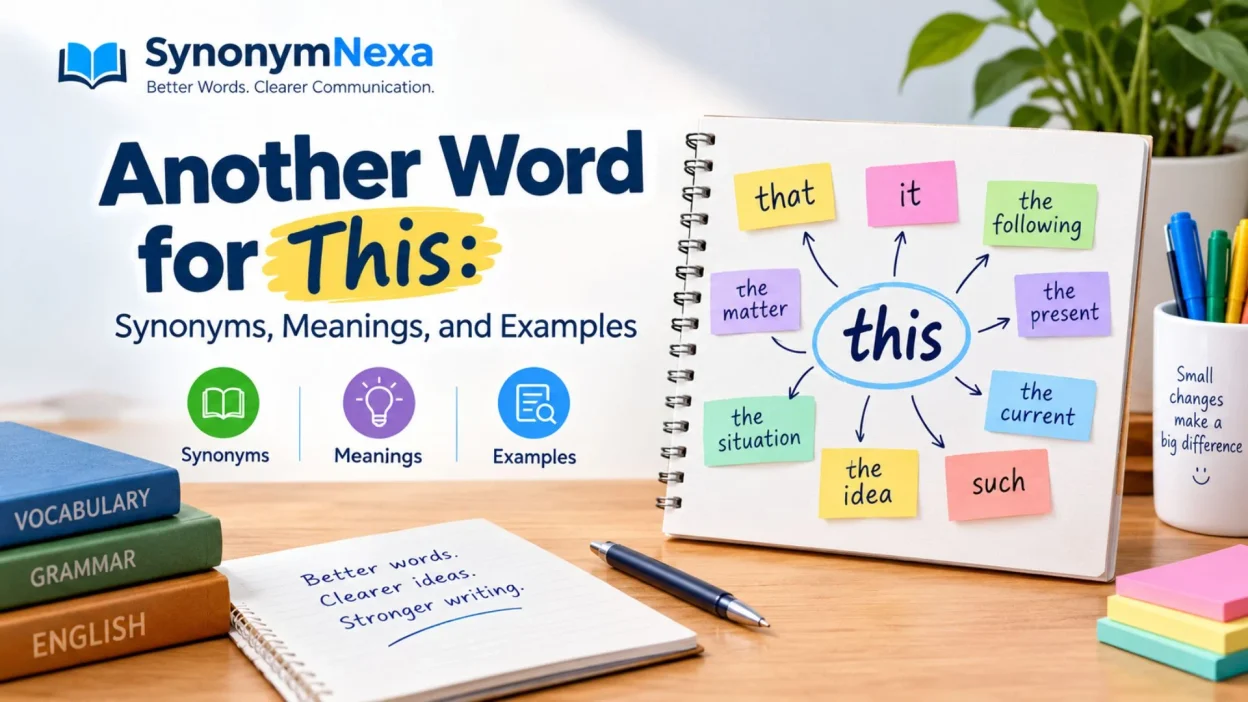
Several words and phrases can replace “this,” although they are not always interchangeable. The following table highlights some useful alternatives and their meanings.
| Synonym or alternative | Meaning or use | Example |
|---|---|---|
| That | Refers to a particular thing or idea | That seems like a good option. |
| It | Refers to something already identified | It looks beautiful. |
| The following | Introduces information that comes next | Read the following instructions. |
| The present | Refers to the current time or situation | The present arrangement works well. |
| The current | Describes something happening or existing now | The current policy needs review. |
| Such | Refers to something of a particular kind | Such behavior is unacceptable. |
| The aforementioned | Refers to something mentioned earlier | The aforementioned rule applies here. |
| The above | Refers to information presented earlier | The above example illustrates the point. |
| This particular | Emphasizes a specific item | This particular method is effective. |
| The matter | Refers to a subject or issue | The matter requires attention. |
| The situation | Refers to a set of circumstances | The situation remains uncertain. |
| The idea | Refers to a thought or concept | The idea deserves further discussion. |
However, some alternatives are more natural in particular settings. For everyday conversation, “that” and “it” are often suitable. In contrast, “the aforementioned” is more formal and usually works best in legal, technical, or academic documents.
Another Word for “This” in Different Contexts
Choosing the right replacement becomes easier when you consider what “this” refers to. For instance, a physical object, an idea, and a current situation may require different alternatives.
When Referring to a Thing
When “this” identifies a particular object, you can often use “that,” “it,” or the object’s actual name.
Examples:
- Original: This is my favorite shirt.
- Alternative: That is my favorite shirt.
- More specific: This shirt is my favorite.
The best choice depends on the intended meaning. “That” may suggest greater distance or a contrast, while “it” usually refers to something already identified.
When Referring to an Idea
When “this” refers to a thought, argument, or explanation, replacing it with a specific noun can make your writing clearer.
Examples:
- Original: This is an interesting idea.
- Alternative: This concept is interesting.
- Alternative: The proposal is interesting.
Similarly, instead of writing “This proves my point,” you could write “This evidence supports my argument.” The revised sentence tells readers exactly what supports the argument.
When Referring to a Situation
When “this” describes an event or circumstance, alternatives include “the situation,” “the issue,” “the problem,” and “the development.”
Examples:
- Original: This is difficult to manage.
- Alternative: The situation is difficult to manage.
- Alternative: The problem is difficult to manage.
Nevertheless, choose a noun that accurately describes the circumstances. A situation is not necessarily a problem, and an issue may be different from an event.
Formal Synonyms for “This”
In professional, academic, and business writing, you may want an alternative that sounds precise and polished. However, formal language should still feel natural.
The Aforementioned
“The aforementioned” refers to a person, item, or matter already mentioned. It is common in legal and formal documents.
Example: “The aforementioned conditions must be met before approval.”
Use this expression when the reference is unmistakable. Otherwise, repeating the specific name or term may be clearer.
The Present
“The present” refers to the current time, state, or circumstances.
Example: “The present arrangement will remain in place until further notice.”
This phrase is useful in official reports and business communication. However, it does not replace every use of “this.”
The Current
“The current” describes something that exists or happens now.
Example: “The current system requires several improvements.”
It works well when discussing policies, processes, systems, and conditions. Additionally, it helps distinguish existing arrangements from previous or future ones.
The Following
“The following” introduces information that appears immediately afterward.
Example: “Please consider the following recommendations.”
This is especially useful before a list, explanation, or set of instructions. Unlike “this,” it specifically directs the reader toward upcoming information.
Such
“Such” refers to a person or thing of the type already described.
Example: “Such an approach may reduce unnecessary costs.”
Although it can sound formal, “such” does not mean exactly the same thing as “this.” Use it when the surrounding sentence supports that meaning.
Informal Alternatives to “This”
In everyday conversation, simple words usually sound more natural than formal expressions. Therefore, you can often replace “this” with “that,” “it,” or a short descriptive phrase.
That
“That” is useful when pointing to something or referring to an idea that has already been discussed.
Example: “That sounds great!”
It can also express a reaction to a previous statement. For instance, “That was a clever solution” refers to a solution already known to the speaker and listener.
It
“It” works when the thing being discussed is clear from the surrounding conversation.
Example: “I bought a new phone. It works perfectly.”
Here, “it” replaces the repeated phrase “a new phone.” As a result, the sentence sounds smoother.
This One
“This one” identifies a particular item among several choices.
Example: “I prefer this one because it is easier to use.”
This expression is particularly helpful when comparing products, clothes, books, or other objects.
The Thing
“The thing” is an informal alternative when the exact name is unknown or unnecessary.
Example: “The thing I like most is its simplicity.”
However, avoid relying on this phrase too often in formal writing. A specific noun usually communicates the intended meaning more clearly.
Another Word for “This” in Academic Writing
Academic writing values precision, clarity, and logical connections. Therefore, rather than replacing every instance of “this” with another single word, consider rewriting the sentence.
Use a Specific Noun
A vague reference can make an academic argument difficult to follow.
- Vague: This demonstrates the importance of education.
- Clearer: This finding demonstrates the importance of education.
- More specific: The survey results demonstrate the importance of education.
The final version identifies the evidence supporting the claim. Consequently, readers can understand the connection more easily.
Use “These Findings” or “This Result”
When referring to research, experiments, or analysis, use language that identifies the relevant evidence.
Examples:
- “These findings support the original hypothesis.”
- “This result suggests a possible relationship.”
- “The evidence indicates a significant difference.”
However, only use these alternatives when they accurately describe the information being discussed.
Use “The Argument” or “The Claim”
When explaining a point in an essay, replace a vague reference with the actual subject.
Original: “This is not convincing.”
Improved: “The argument is not convincing.”
More specific: “The argument lacks sufficient evidence.”
The last example explains why the argument is weak. As a result, it offers more useful information than a simple substitution.
Another Word for “This” in Business Writing
Business writing often benefits from direct, specific language. In emails, reports, proposals, and presentations, a suitable replacement can help readers understand your message quickly.
| Original phrase | Better alternative | Example |
|---|---|---|
| This issue | The issue | The issue requires immediate attention. |
| This plan | The proposed plan | The proposed plan outlines our next steps. |
| This information | These details | These details will help us proceed. |
| This decision | The decision | The decision affects the project timeline. |
| This document | The report | The report contains the latest figures. |
| This process | The procedure | The procedure needs to be updated. |
These alternatives are particularly useful when the subject has already been identified. Moreover, they reduce repetition and make business communication easier to scan.
For example, instead of writing “This is why we need to change this,” you could write “The results explain why we need to revise the process.” The revised sentence is more precise and professional.
Common Phrases Using “This” and Their Alternatives
Sometimes, the easiest way to improve your writing is to replace a complete phrase rather than one word.
| Phrase with “this” | Alternative phrase |
|---|---|
| This is because | The reason is that |
| This means that | In other words |
| This shows that | This indicates that |
| This is important | This matters |
| This kind of | This type of |
| This is why | For this reason |
| At this time | Currently |
| In this case | Under these circumstances |
| This way | By doing so |
| This issue | The problem or concern |
| This approach | The method |
| This point | This argument or detail |
The alternatives depend on the sentence. For example, “currently” can replace “at this time” when discussing the present, but it cannot replace every phrase containing “this.”
Similarly, “in other words” restates an idea, while “this means that” introduces an explanation or consequence. Use the phrase that best expresses your intended relationship between ideas.
Words Related to “This” That Are Not Always Synonyms
Although several words can replace “this,” some have different grammatical roles or meanings. Understanding these differences will help you avoid awkward sentences.
This vs. That
“This” often identifies something near the speaker or something currently being emphasized. In contrast, “that” often points to something farther away or refers to something already mentioned.
Examples:
- “This bag is mine.” The bag is being identified as the relevant item.
- “That bag is yours.” The other bag is being identified.
The distinction can also be figurative rather than physical. Context determines which word sounds natural.
This vs. It
“This” can introduce or emphasize something, while “it” commonly refers back to an already identified noun or situation.
Examples:
- “This is my new laptop.”
- “It has a fast processor.”
The second sentence uses “it” because the laptop has already been introduced. Therefore, substituting “this” for “it” in every sentence may create unnecessary repetition.
This vs. These
“This” is generally used with singular nouns, while “these” is used with plural nouns.
Examples:
- “This book is useful.”
- “These books are useful.”
Although both words identify particular things, they differ in number. Consequently, “these” is not a direct replacement for singular “this” without changing the sentence.
This vs. Such
“This” usually points to a specific thing, whereas “such” refers to a particular kind, quality, or previously described situation.
Examples:
- “This method works well.”
- “Such methods work well.”
The first sentence identifies a particular method. The second refers to methods of the type being discussed.
How to Choose the Best Synonym for “This”
The right alternative depends on your meaning, audience, and writing style. Before changing the word, consider these practical tips.
- Identify the reference. Determine whether “this” refers to an object, idea, event, result, or situation.
- Check the context. Use “that” for a suitable demonstrative reference and “it” when the subject is already clear.
- Prefer specific nouns. Replace vague wording with terms such as “the report,” “the result,” or “the decision” when appropriate.
- Match the tone. Everyday writing often favors simple words, while formal documents may require more precise expressions.
- Check the grammar. Make sure the replacement agrees with the sentence and preserves its intended meaning.
- Read the sentence aloud. If the alternative sounds unnatural, choose a clearer expression instead.
Ultimately, the best synonym is not necessarily the most sophisticated word. It is the one that communicates your meaning accurately and naturally.
FAQ Section
What is the best synonym for “this”?
The best synonym depends on the context. “That,” “it,” “the following,” and a specific noun can all work in suitable sentences. However, each has a different purpose.
What is another word for “this” in formal writing?
Formal alternatives include “the aforementioned,” “the present,” “the current,” and “the following.” Nevertheless, a precise noun often makes formal writing clearer and easier to understand.
What can I use instead of “this” in an essay?
In an essay, you can use phrases such as “this finding,” “the argument,” “the evidence,” or “the result.” These expressions identify the subject more clearly than a vague reference.
Is “that” a synonym for “this”?
Yes, “that” can replace “this” in some contexts. However, the two words can indicate different distances, emphasis, or references. Therefore, they are not interchangeable in every sentence.
How can I avoid repeating the word “this”?
First, identify what the word refers to. Then, replace it with a suitable noun, “it,” “that,” or a descriptive phrase. Additionally, rewrite the sentence when doing so improves clarity.
Is “it” the same as “this”?
No. “It” usually refers to something already identified, while “this” can point to something specific or introduce a new idea. The correct choice depends on the sentence and its context.
Conclusion
Finding another word for this can make your writing clearer, more natural, and less repetitive. Useful alternatives include “that,” “it,” “the following,” “the current,” and specific nouns such as “the result,” “the idea,” or “the situation.” However, no single synonym works in every context.
For the best results, consider what you are referring to and choose a word that preserves your intended meaning. In academic and professional writing, specificity is often more effective than simply replacing one word with another. Overall, clear vocabulary helps readers understand your message with less effort. Explore more vocabulary guides on SynonymNexa to improve your English and strengthen your writing skills.