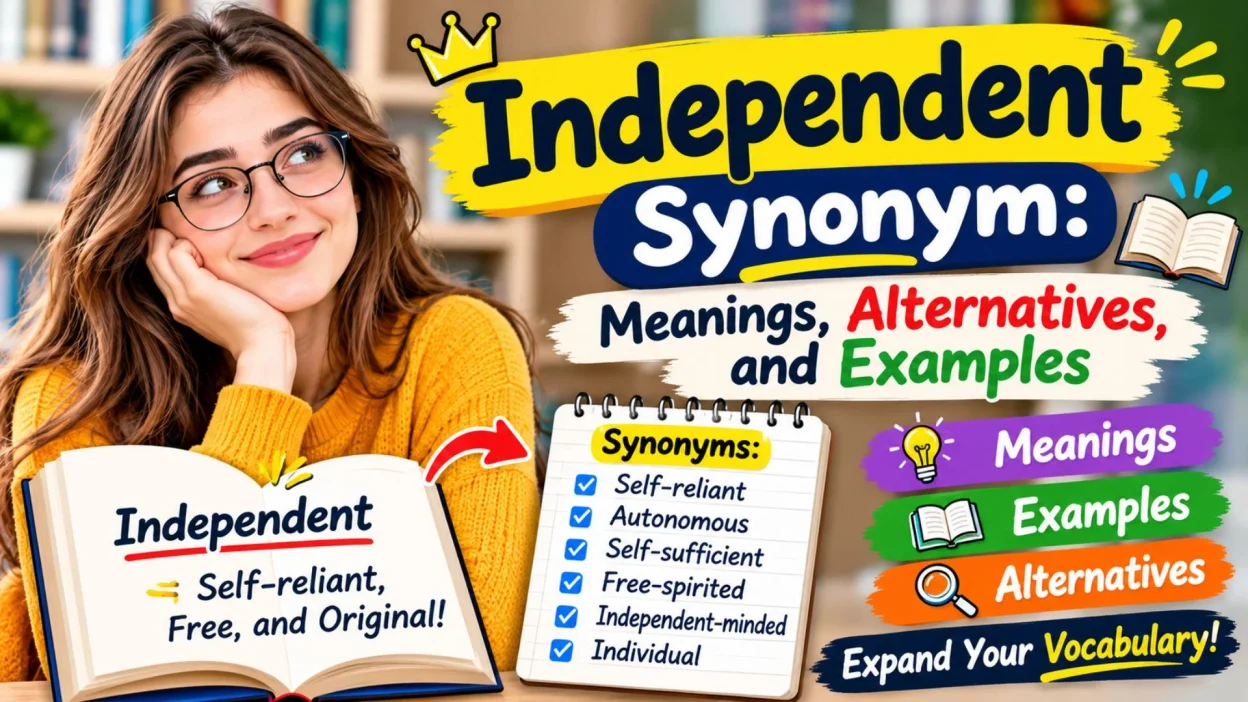
The word independent describes someone or something that can operate, make decisions, or exist without relying heavily on others. However, using the same word repeatedly can make your writing sound less natural. Choosing the right independent synonym helps you express ideas more clearly, whether you are describing a person, a business, a country, or an individual decision.
Common alternatives include self-reliant, autonomous, self-sufficient, free, and separate. Although these words share some similarities, they do not always mean exactly the same thing. Some emphasize personal responsibility, while others describe freedom, authority, or separation.
In this guide, you will discover useful alternatives, understand their differences, and learn how to use them in everyday conversations, academic writing, and professional communication.
📚 What Does Independent Mean?
Independent means free from another person’s control, influence, or support. It can describe someone who makes their own decisions, an organization that operates without outside control, or a country that governs itself.
The meaning depends on the situation. For example, an independent person may manage everyday responsibilities without depending on others. Similarly, an independent company may make its own business decisions without being controlled by a larger organization.
Here are some common uses:
- Personal independence: Managing your own responsibilities and decisions.
- Financial independence: Having enough financial resources to support yourself.
- Political independence: Governing a country without foreign control.
- Professional independence: Working or making decisions without unnecessary supervision.
- Independent thinking: Forming opinions using your own judgment.
Understanding the context is important because not every alternative fits all these meanings.
🔤 Best Synonyms for Independent
Several words can replace independent, but the best choice depends on what you want to communicate.
| Synonym | Meaning |
|---|---|
| Self-reliant | Able to depend on yourself |
| Autonomous | Having the freedom to govern or control yourself |
| Self-sufficient | Having what you need without outside help |
| Free | Not controlled or restricted |
| Unrestricted | Not limited by rules or conditions |
| Sovereign | Having independent authority, especially political authority |
| Separate | Existing apart from something else |
| Unaffiliated | Not officially connected to a particular group |
| Individual | Separate or belonging to one person |
| Uncontrolled | Not directed or managed by another |
| Self-governing | Managing your own affairs |
| Independent-minded | Thinking and deciding for yourself |
| Detached | Separate or emotionally uninvolved |
| Impartial | Not favoring one side |
| Unbiased | Not influenced by personal preferences or prejudice |
Some of these alternatives have narrower meanings. For example, impartial and unbiased are useful when discussing opinions or decisions, but they are not general replacements for independent.
💡 Self-Reliant: An Alternative for Personal Independence
Self-reliant describes someone who trusts their own abilities and handles responsibilities without regularly depending on others.
It is especially useful when discussing confidence, personal development, and practical skills.
Examples:
- She became self-reliant after moving into her own apartment.
- A self-reliant person knows how to handle everyday challenges.
- He is financially responsible and highly self-reliant.
When to use it: Choose self-reliant when you want to emphasize personal ability and responsibility rather than freedom from authority.
🏢 Autonomous: An Alternative for Freedom of Control
Autonomous means having the authority or ability to make decisions independently. It is commonly used in formal, academic, organizational, and technical contexts.
For example, an autonomous department may make certain decisions without requiring approval from the entire organization.
Examples:
- The university operates as an autonomous institution.
- Employees have autonomous control over some daily tasks.
- The region has authority over its internal affairs.
When to use it: Use autonomous when discussing decision-making authority, organizational control, or self-government.
🌱 Self-Sufficient: An Alternative for Managing Without Help
Self-sufficient describes someone or something that has enough resources or abilities to meet its own needs.
It often appears in discussions about finances, food production, communities, and personal living.
Examples:
- The family hopes to become self-sufficient by growing its own vegetables.
- She worked toward becoming financially self-sufficient.
- A self-sufficient community can produce many of the resources it needs.
When to use it: Choose self-sufficient when the main idea is having the resources or skills needed without relying on outside support.
🕊️ Free: An Alternative for Lack of Control
Free can describe a person, group, or organization that is not under another person’s control or authority.
However, the word has several meanings, including freedom from restrictions, cost, or obligations. Therefore, the surrounding sentence should make the intended meaning clear.
Examples:
- The people wanted to live in a free society.
- She felt free to express her opinions.
- The organization remained free from outside interference.
When to use it: Use free when emphasizing liberty, personal choice, or the absence of restrictions.
🌍 Sovereign: An Alternative for Political Independence
Sovereign is a more specific word associated with political authority and the power of a state to govern itself.
It is particularly useful when discussing nations, governments, and international relations.
Examples:
- The country is a sovereign state.
- Every sovereign nation has authority over its territory.
- The agreement recognized the region’s sovereign rights.
When to use it: Choose sovereign when discussing a country’s political authority or self-governing status. It is not normally a replacement for independent when describing an ordinary person.
🧩 Separate: An Alternative for Being Unconnected
Separate means existing apart from something else or not being joined to it.
It can sometimes replace independent when the intended meaning involves different units, departments, projects, or organizations.
Examples:
- The company operates through two separate divisions.
- Each student completed an independent project.
- The organization maintains a separate office.
When to use it: Use separate when you mean distinct or unconnected, rather than personally free or self-reliant.
📝 Independent Synonyms for Different Contexts
The right alternative depends on the sentence. A word that works well in a personal description may sound unsuitable in a business report or political discussion.
Here are useful options for different situations.
Independent Person
When describing someone who makes personal decisions and manages responsibilities, consider:
- Self-reliant
- Self-sufficient
- Independent-minded
- Self-supporting
- Confident
- Responsible
- Self-directed
Example: She is an independent person who makes thoughtful decisions.
Alternative: She is a self-reliant person who makes thoughtful decisions.
Financially Independent
When discussing money and personal finances, these expressions may work:
- Financially self-sufficient
- Financially secure
- Self-supporting
- Economically independent
- Financially autonomous
Example: He wants to become financially independent before retirement.
Alternative: He wants to become financially self-sufficient before retirement.
Remember that financially secure and financially independent are related, but they are not identical. Financial security emphasizes stability, while financial independence emphasizes not needing financial support from others.
Independent Business
When describing a business that operates without being controlled by another company, consider:
- Privately owned
- Unaffiliated
- Autonomous
- Self-managed
- Independently operated
Example: She owns an independent bookstore.
Alternative: She owns a privately operated bookstore.
The alternative should reflect the actual ownership and management arrangement. An unaffiliated business, for example, is not necessarily privately owned.
Independent Thinking
When discussing original opinions and personal judgment, useful alternatives include:
- Original thinking
- Critical thinking
- Independent-mindedness
- Self-directed thinking
- Individual judgment
Example: Good education encourages independent thinking.
Alternative: Good education encourages critical thinking.
These expressions overlap, but critical thinking specifically emphasizes examining information and evaluating ideas.
Independent Country
When discussing a country that governs itself, suitable alternatives include:
- Sovereign
- Self-governing
- Autonomous
- Free
- Self-ruling
Example: The nation became independent after a long political struggle.
Alternative: The nation became self-governing after a long political struggle.
🗣️ Formal and Informal Alternatives for Independent
Different situations call for different vocabulary. A formal report may need a more precise word, while casual conversation usually sounds better with simple language.
| Formal Alternative | Informal Alternative |
|---|---|
| Autonomous | On your own |
| Self-sufficient | Able to manage yourself |
| Self-governing | Running things yourself |
| Unaffiliated | Not connected |
| Sovereign | Free to govern itself |
| Self-directed | Doing things your own way |
| Financially independent | Supporting yourself |
Formal example:
The organization maintains an autonomous administrative structure.
Informal example:
She likes doing things on her own.
Both sentences communicate independence, but their tone and level of detail are different.
⚖️ Independent vs. Similar Words: What Is the Difference?
Some words appear interchangeable but communicate slightly different ideas. Understanding these differences helps you avoid awkward or inaccurate sentences.
| Word | Main Meaning | Best Context |
|---|---|---|
| Independent | Not controlled or dependent on others | General use |
| Self-reliant | Able to handle things yourself | Personal abilities |
| Self-sufficient | Able to meet your own needs | Resources and support |
| Autonomous | Having decision-making authority | Organizations and systems |
| Sovereign | Having supreme governing authority | Countries and states |
| Separate | Existing apart from something | Objects and organizations |
| Unaffiliated | Not officially connected | Groups and institutions |
| Impartial | Not favoring either side | Decisions and opinions |
Independent vs. Self-Reliant
Independent describes freedom from control or dependence, while self-reliant focuses on trusting your own abilities.
For example, an independent worker may choose their working arrangements. A self-reliant worker can manage tasks without constantly asking for assistance.
Independent vs. Autonomous
Independent is a broad term, while autonomous often emphasizes the authority to make decisions.
For example, a business can be independently owned, while an autonomous department may have permission to make its own operational decisions.
Independent vs. Self-Sufficient
Self-sufficient specifically describes having the resources or abilities needed to manage without outside support.
A person can be independent in decision-making without being completely self-sufficient financially.
Independent vs. Unaffiliated
Unaffiliated means not officially connected to a particular organization, group, or institution.
An independent journalist, for instance, may work without being employed by a major news organization. However, unaffiliated does not automatically mean unbiased or completely independent.
🚫 Words That Are Not Always Synonyms of Independent
Some related words may fit particular sentences but should not be treated as direct replacements.
- Impartial: Means fair and not favoring one side. An independent person is not automatically impartial.
- Confident: Describes belief in your own abilities. Confidence does not necessarily mean independence.
- Lonely: Describes feeling unhappy because of a lack of companionship. Independence does not mean loneliness.
- Individual: Refers to one person or a single unit. It does not always suggest freedom from control.
- Unique: Means different or distinctive. Something independent is not necessarily unique.
- Detached: Can mean separate or emotionally uninvolved. It does not always describe freedom or self-reliance.
Choosing the correct word keeps your writing accurate. Consider the intended meaning before replacing independent with a similar expression.
✍️ Example Sentences Using Independent Synonyms
Seeing alternatives in complete sentences makes it easier to understand how they work in everyday English.
| Original Sentence | Alternative Sentence |
|---|---|
| She is an independent woman. | She is a self-reliant woman. |
| The department works independently. | The department operates autonomously. |
| He wants to become financially independent. | He wants to become financially self-sufficient. |
| The country became independent. | The country became sovereign. |
| She has an independent opinion. | She has an individual viewpoint. |
| The company is independent. | The company is privately operated. |
| He prefers independent work. | He prefers self-directed work. |
| The organization is independent of the group. | The organization is unaffiliated with the group. |
Not every alternative preserves the exact meaning in every situation. Read the full sentence to make sure the replacement communicates what you intend.
🎯 How to Choose the Best Independent Synonym
Before selecting an alternative, think about what kind of independence you are describing.
- For personal responsibility: Choose self-reliant.
- For managing your own needs: Choose self-sufficient.
- For decision-making authority: Choose autonomous.
- For political freedom: Choose sovereign.
- For freedom from restrictions: Choose free.
- For something existing apart: Choose separate.
- For having no official connection: Choose unaffiliated.
- For original judgment: Choose independent-minded.
The most effective synonym is not necessarily the most complicated one. A simple, accurate word usually makes your writing easier to understand.
❓ FAQ Section
What is the best synonym for independent?
Self-reliant is one of the closest alternatives when describing a person who manages responsibilities without depending on others. However, autonomous, self-sufficient, and free may be better in different contexts.
What is another word for independent person?
You can describe an independent person as self-reliant, self-sufficient, self-directed, or independent-minded. Each expression highlights a slightly different quality.
What is a formal synonym for independent?
Autonomous, self-governing, self-sufficient, and unaffiliated are useful formal alternatives. The correct choice depends on whether you are discussing authority, resources, or organizational connections.
What is the opposite of independent?
Common antonyms include dependent, reliant, controlled, subordinate, and dependent on others. The best opposite depends on the meaning of the original sentence.
Is self-reliant the same as independent?
They are closely related but not identical. Independent emphasizes freedom from control or dependence, while self-reliant focuses on managing responsibilities through your own abilities.
What is another word for financially independent?
Financially self-sufficient, self-supporting, and economically independent are useful alternatives. Financially secure is also related, although it emphasizes financial stability rather than freedom from financial support.
Can autonomous replace independent?
Yes, in situations involving decision-making authority or self-government. However, autonomous is more specific and may sound too formal in everyday conversation.
🏁 Conclusion
Choosing the right independent synonym makes your writing more natural, precise, and engaging. Words such as self-reliant, autonomous, self-sufficient, sovereign, and unaffiliated offer different ways to describe freedom, responsibility, and decision-making.
The key is to consider the context before choosing an alternative. Use self-reliant for personal abilities, autonomous for decision-making authority, and sovereign for political independence. With the right word, you can communicate your ideas clearly without repeating the same expression.