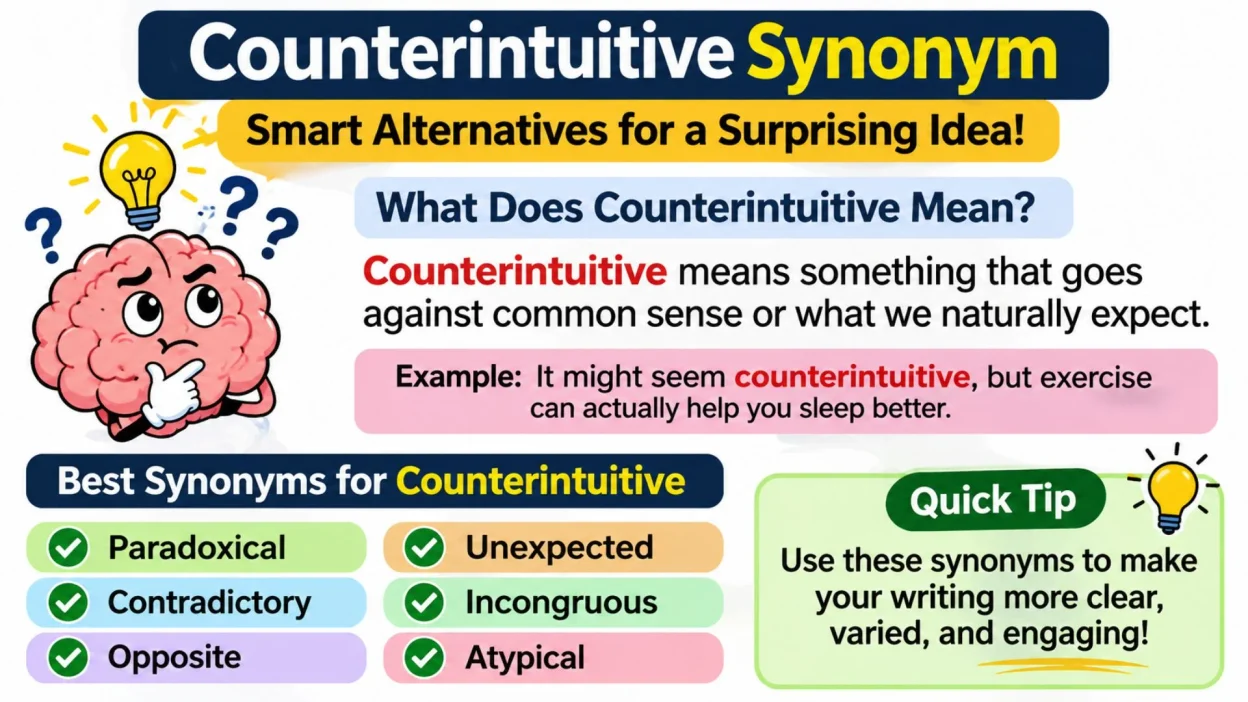
Finding the right counterintuitive synonym can make your writing clearer, more precise, and easier to understand. The word counterintuitive describes something that seems opposite to what common sense, ordinary expectations, or initial reasoning would suggest. For example, a simple solution may produce better results than a complicated one, even when people expect the opposite.
However, not every alternative has exactly the same meaning. Words such as unexpected, paradoxical, unconventional, and illogical express different shades of meaning. Therefore, choosing the right replacement depends on the context, tone, and message you want to communicate.
In this guide, you will discover 25 useful alternatives to counterintuitive, along with their meanings, example sentences, differences, and practical usage tips. Whether you are writing an academic paper, professional report, blog post, or everyday message, these words can help you express surprising ideas more effectively.
📘 What Does Counterintuitive Mean?
Before exploring alternatives, it helps to understand the original word. Counterintuitive combines the idea of going against something with intuition, or the natural understanding people form without deliberate reasoning.
In simple terms, something is counterintuitive when it does not match what you would normally expect.
For example, you might assume that working longer hours always increases productivity. However, research or personal experience may show that shorter, focused work sessions produce better results. That outcome can be described as counterintuitive.
The word is commonly used in several situations:
- Everyday situations: Something happens differently from what people expect.
- Science: An observation challenges an ordinary assumption.
- Psychology: Human behavior differs from what seems logically predictable.
- Business: A strategy succeeds despite appearing unusual.
- Education: A result challenges what students initially believe.
- Technology: A simple design performs better than a complicated one.
- Health and fitness: A common belief does not match the available evidence.
- Problem-solving: An unexpected approach produces a useful result.
In most cases, counterintuitive does not mean completely illogical. Instead, it suggests that an idea seems surprising or unusual before someone understands the explanation behind it.
🔤 25 Best Counterintuitive Synonyms and Their Meanings
The following alternatives can help you avoid repeating counterintuitive in your writing. Each word has a slightly different meaning, so consider the example sentence before using it.
1. Unexpected
Meaning: Something that happens without being predicted or anticipated.
Unexpected is one of the simplest alternatives to counterintuitive. It works when an outcome surprises people, although it does not always suggest that the result goes against common sense.
Example: The unexpected results changed the team’s original strategy.
2. Paradoxical
Meaning: Seemingly contradictory or inconsistent, yet possibly containing a deeper truth.
Paradoxical is useful when an idea appears to contradict itself or an accepted belief. It often suits philosophical, academic, and analytical writing.
Example: It seems paradoxical that slowing down can sometimes help people finish work faster.
3. Unconventional
Meaning: Different from traditional methods, accepted customs, or usual practices.
Choose unconventional when an approach differs from what most people normally do. It describes an unusual method rather than necessarily an unexpected result.
Example: The company adopted an unconventional marketing strategy that attracted new customers.
4. Surprising
Meaning: Causing someone to feel surprise because something is different from what they expected.
Surprising is a straightforward alternative for everyday communication. It is less technical than counterintuitive and works well when the main focus is the reaction of the audience.
Example: The surprising discovery challenged the team’s earlier assumptions.
5. Illogical
Meaning: Not following reasonable logic or clear principles of reasoning.
Illogical is appropriate when something appears unreasonable or does not make sense logically. However, it is not always interchangeable with counterintuitive because an idea can seem counterintuitive while still being correct.
Example: It may seem illogical to spend money now to reduce future expenses.
6. Counterproductive
Meaning: Producing an effect opposite to the intended goal.
Counterproductive is useful when an action makes a problem worse instead of solving it. It describes an unwanted result rather than simply an unexpected one.
Example: Constantly checking messages can be counterproductive when completing a difficult task.
7. Incongruous
Meaning: Not matching or fitting with the surrounding circumstances, ideas, or expectations.
Incongruous works when something appears out of place or inconsistent with its surroundings. It is particularly useful in formal writing and detailed descriptions.
Example: His cheerful response seemed incongruous with the seriousness of the situation.
8. Counter-normal
Meaning: Going against what is generally considered normal or usual.
Counter-normal is a less common expression. It may be useful in specialized discussions, but unusual or unconventional will usually sound more natural in everyday writing.
Example: The experiment explored counter-normal patterns of behavior.
9. Unpredictable
Meaning: Difficult or impossible to anticipate with confidence.
Use unpredictable when an event, person, or result cannot easily be forecast. Unlike counterintuitive, it does not necessarily mean that the outcome opposes common sense.
Example: The unpredictable findings forced researchers to reconsider their expectations.
10. Counterlogical
Meaning: Appearing to go against logical expectations or ordinary reasoning.
Counterlogical is a rare expression and may sound unnatural in general writing. In most contexts, paradoxical or counterintuitive communicates the idea more clearly.
Example: The proposal appeared counterlogical until the financial details were explained.
11. Peculiar
Meaning: Unusual, distinctive, or different from what is commonly expected.
Peculiar is useful when describing something that seems strange or uncommon. It is less precise than counterintuitive because it does not necessarily involve a conflict with expectations.
Example: There was a peculiar pattern in the results that nobody initially noticed.
12. Contrary
Meaning: Opposite to an idea, statement, belief, or expectation.
Contrary is a useful choice when you want to emphasize opposition. It often appears in expressions such as contrary to expectations or contrary to popular belief.
Example: Contrary to expectations, the smaller team completed the project first.
13. Absurd
Meaning: Completely unreasonable, ridiculous, or difficult to accept as sensible.
Absurd is stronger than counterintuitive. Use it when an idea seems extremely unreasonable, not merely surprising.
Example: At first, the suggestion sounded absurd, but the results eventually supported it.
14. Anomalous
Meaning: Different from what is normal, typical, or expected.
Anomalous is particularly useful in science, research, statistics, and technical reports. It describes an unusual observation or result that differs from an established pattern.
Example: Researchers investigated an anomalous reading in the final experiment.
15. Counterexpectational
Meaning: Going against what people expect.
This is an uncommon and specialized construction. Although readers may understand it, contrary to expectations is usually a more natural alternative.
Example: The counterexpectational result surprised the entire research team.
16. Unorthodox
Meaning: Different from established beliefs, traditional practices, or accepted methods.
Unorthodox is a strong option when discussing unusual approaches or unconventional thinking. It often carries a neutral or positive meaning.
Example: Her unorthodox teaching method encouraged students to solve problems creatively.
17. Inconsistent
Meaning: Not staying the same or not agreeing with another fact, statement, or principle.
Inconsistent can work when an observation conflicts with an existing pattern. However, it usually refers to a lack of agreement rather than an unexpected outcome.
Example: The latest findings were inconsistent with the team’s original prediction.
18. Counterintuitive-Looking
Meaning: Appearing to go against common sense or ordinary expectations.
This descriptive phrase can help explain an idea without replacing the original word with another technical term. It is generally better suited to informal explanations than formal academic writing.
Example: The counterintuitive-looking design became easier to use after testing.
19. Discrepant
Meaning: Showing a difference or disagreement between two things that would normally be expected to match.
Discrepant is useful in research and formal discussions. It describes conflicting information, figures, or observations.
Example: The discrepant measurements led the scientists to repeat the experiment.
20. Unanticipated
Meaning: Not expected or planned in advance.
Unanticipated is a formal alternative to unexpected. It works well in business reports, research papers, and professional communication.
Example: The unanticipated outcome created a new opportunity for the business.
21. Contrary to Common Sense
Meaning: Opposing what people generally believe to be reasonable or obvious.
This phrase communicates the central idea of counterintuitive in accessible language. It is especially useful when writing for readers who may not know the original word.
Example: Contrary to common sense, adding more features did not improve the product.
22. Seemingly Illogical
Meaning: Appearing unreasonable or inconsistent with logic at first.
Seemingly illogical is useful when an idea initially appears incorrect but may have a reasonable explanation. The word seemingly makes the statement less absolute.
Example: The seemingly illogical decision helped the company avoid greater losses.
23. Counterintuitive in Nature
Meaning: Naturally appearing to conflict with ordinary expectations.
This is a descriptive phrase rather than a direct one-word synonym. It can help explain an unusual principle or result in educational writing.
Example: The relationship between stress and performance can be counterintuitive in nature.
24. Nonintuitive
Meaning: Not easily understood or recognized through intuition alone.
Nonintuitive is useful in technical subjects, user-interface design, mathematics, and scientific explanations. It often suggests that someone needs instructions, evidence, or careful reasoning to understand something.
Example: The software’s nonintuitive layout made the first-time experience difficult.
25. Counterassumptive
Meaning: Challenging or opposing an assumption that people commonly accept.
Counterassumptive is an uncommon formation rather than a widely established everyday synonym. In polished writing, assumption-challenging or contrary to common assumptions will usually be clearer.
Example: The assumption-challenging evidence changed how the team understood the problem.
🧠 Best Counterintuitive Synonyms for Different Contexts
Choosing a synonym becomes easier when you consider what you want to communicate. Some alternatives describe a surprising result, while others highlight an unusual method or a conflict with accepted beliefs.
Use these context-based suggestions to select a word that fits your sentence naturally.
For academic and scientific writing
Academic writing often requires precise language. Instead of choosing a general word, select an alternative that describes the specific relationship between an observation and an existing theory.
- Paradoxical: Best when an idea appears contradictory but may have a deeper explanation.
- Anomalous: Suitable for an observation that differs from an established pattern.
- Nonintuitive: Useful when a result is difficult to understand through ordinary intuition.
- Discrepant: Appropriate when findings or measurements do not agree.
- Unexpected: A clear choice for a result that researchers did not anticipate.
Example: The anomalous findings challenged the researchers’ initial assumptions.
For business and professional writing
Business communication often discusses strategies, decisions, and outcomes that differ from expectations. Choose a synonym that explains whether the approach is unusual or produces an unexpected effect.
- Unconventional: Describes a strategy that differs from common business practices.
- Unorthodox: Highlights a method that challenges established approaches.
- Unexpected: Describes a surprising business result.
- Counterproductive: Explains an action that works against a business goal.
- Unanticipated: Suitable for developments that were not planned.
Example: The company’s unconventional strategy helped it reach a new audience.
For everyday conversations
Simple words are usually more effective in casual communication. You do not need a technical synonym when a familiar expression can explain your point.
- Surprising: Use it when something catches people off guard.
- Unexpected: Choose it for an outcome nobody predicted.
- Strange: Describe something that seems unusual.
- Unusual: Explain something that differs from the normal pattern.
- Contrary to expectations: Use this phrase when an outcome differs from what people believed would happen.
Example: It was surprising that the cheaper option lasted longer.
For persuasive and analytical writing
When discussing beliefs, assumptions, or arguments, choose words that emphasize the difference between expectations and evidence.
- Paradoxical: Highlights an apparent contradiction.
- Contrary: Shows opposition to a belief or expectation.
- Seemingly illogical: Describes something that appears unreasonable at first.
- Assumption-challenging: Explains how evidence questions an accepted belief.
- Unconventional: Highlights a different way of approaching an issue.
Example: The assumption-challenging evidence encouraged readers to reconsider their position.
✍️ Counterintuitive Synonyms in Example Sentences
A synonym is most useful when you can apply it correctly in a complete sentence. The examples below show how different alternatives can replace counterintuitive while keeping the central meaning clear.
Notice that the best replacement changes according to the message. In some sentences, the alternative describes an unexpected result; in others, it explains a contradiction or an unusual approach.
- Counterintuitive: The result was counterintuitive because higher prices increased demand.
- Unexpected: The result was unexpected because higher prices increased demand.
- Paradoxical: It was paradoxical that reducing the available options improved customer satisfaction.
- Unconventional: The business adopted an unconventional approach to attract customers.
- Surprising: The surprising discovery changed the direction of the research.
- Illogical: The decision seemed illogical until the long-term benefits became clear.
- Counterproductive: Skipping regular breaks can be counterproductive when completing demanding work.
- Incongruous: His relaxed attitude seemed incongruous with the urgent situation.
- Unpredictable: The unpredictable response made the original forecast less reliable.
- Anomalous: The anomalous result required additional investigation.
- Unorthodox: The teacher used an unorthodox method to explain a difficult subject.
- Contrary: Contrary to popular belief, a longer workday does not always produce better results.
- Unanticipated: The unanticipated outcome created a new challenge for the organization.
- Nonintuitive: The nonintuitive controls required additional instructions.
- Peculiar: A peculiar pattern appeared during the final stage of testing.
These examples also show why you should not replace every occurrence of counterintuitive with the same alternative. A sentence about a surprising discovery may need unexpected, while a sentence about a contradictory idea may be better with paradoxical.
⚖️ Counterintuitive vs. Similar Words: What Is the Difference?
Several words appear similar to counterintuitive, but their meanings are not identical. Understanding these differences helps you avoid inaccurate word choices and improves the quality of your writing.
The following comparisons explain some common points of confusion.
| Word | Main meaning | Best use |
|---|---|---|
| Counterintuitive | Against ordinary intuition or expectations | An idea that initially seems wrong or surprising |
| Unexpected | Not predicted or anticipated | A surprising event or result |
| Paradoxical | Apparently contradictory | An idea that seems to contain a contradiction |
| Unconventional | Different from established methods | An unusual approach or practice |
| Illogical | Not following sound reasoning | A conclusion that lacks logical support |
| Counterproductive | Producing the opposite of the intended effect | An action that makes a goal harder to achieve |
| Unpredictable | Difficult to forecast | An uncertain event or outcome |
| Anomalous | Different from a normal pattern | An unusual observation or measurement |
| Unorthodox | Not following traditional methods | A nontraditional approach |
| Nonintuitive | Not easily understood through intuition | A system or concept that requires explanation |
Counterintuitive vs. Unexpected
Both words describe situations that may surprise people. However, unexpected focuses on whether someone predicted an event, while counterintuitive focuses on whether the result conflicts with ordinary intuition.
For example:
- Unexpected: The meeting ended earlier than planned.
- Counterintuitive: The team became more productive after reducing its working hours.
The first event was simply not anticipated. The second result challenges a common assumption about working longer.
Counterintuitive vs. Paradoxical
Paradoxical describes an apparent contradiction. Counterintuitive describes something that conflicts with what people naturally expect or believe.
For example:
- Counterintuitive: Drinking enough water may help reduce feelings of hunger.
- Paradoxical: The more choices people receive, the less satisfied they may feel.
These meanings can overlap, but paradoxical often emphasizes a contradiction more strongly.
Counterintuitive vs. Unconventional
Unconventional refers to a method or idea that differs from established customs. Counterintuitive refers to an idea that seems to oppose ordinary expectations.
For example:
- Unconventional: The artist used recycled materials to create sculptures.
- Counterintuitive: The simplest design produced the most effective result.
An unconventional method may be surprising, but it does not automatically challenge common sense.
Counterintuitive vs. Illogical
Illogical suggests that something does not follow sound reasoning. Counterintuitive does not necessarily mean that an idea is incorrect.
For example:
- Illogical: The conclusion did not follow from the available evidence.
- Counterintuitive: The evidence showed that a smaller team could complete the task more efficiently.
A counterintuitive result may be supported by strong evidence even if it initially seems unreasonable.
Counterintuitive vs. Counterproductive
Counterproductive describes an action that works against the intended goal. Counterintuitive describes something that conflicts with ordinary expectations.
For example:
- Counterintuitive: Taking short breaks can improve concentration.
- Counterproductive: Taking a break every two minutes can interrupt concentration.
The first statement challenges an assumption. The second describes an action that may prevent someone from achieving a goal.
🎯 How to Choose the Right Counterintuitive Synonym
The best synonym depends on the meaning you want readers to understand. Before replacing the original word, consider whether your sentence describes an unexpected outcome, an unusual approach, or an idea that challenges common sense.
Follow these practical guidelines to make a more accurate choice.
- Identify the main idea: Decide whether you are describing a result, belief, method, or behavior.
- Consider the level of surprise: Use surprising for ordinary situations and paradoxical for apparent contradictions.
- Think about the audience: Everyday readers may understand unexpected more easily than anomalous.
- Match the writing style: Academic reports may benefit from nonintuitive or anomalous, while casual writing may suit unusual.
- Avoid changing the meaning: Do not use illogical when you simply mean surprising.
- Check the sentence structure: Some alternatives work better as phrases, such as contrary to expectations.
- Consider the emotional tone: Absurd can sound critical, whereas unconventional may sound neutral or positive.
- Use the most precise option: A specific word often communicates more than a general synonym.
- Read the sentence aloud: If the replacement sounds awkward, choose a more natural expression.
- Review the surrounding paragraph: Make sure the replacement fits the meaning of the entire discussion.
Quick Word Choice Examples
Here are a few practical situations that show how to select a suitable alternative.
- If a scientific result challenges a theory, choose anomalous or unexpected.
- If an idea appears to contradict itself, choose paradoxical.
- If a business uses a different strategy, choose unconventional.
- If a decision makes a problem worse, choose counterproductive.
- If an event was difficult to predict, choose unpredictable.
- If a system is difficult to understand intuitively, choose nonintuitive.
- If a belief conflicts with evidence, use contrary to the evidence.
- If a statement appears unreasonable, choose seemingly illogical.
🚫 Common Mistakes When Using Counterintuitive Synonyms
Using a synonym incorrectly can change the meaning of a sentence. Although several alternatives are related, they are not always interchangeable.
Avoid these common mistakes when writing academic papers, professional documents, or everyday content.
- Using illogical for every surprising result: A surprising result can be perfectly reasonable once the evidence is understood.
- Treating unexpected as an exact replacement: Unexpected does not necessarily suggest that an outcome goes against common sense.
- Confusing unconventional with paradoxical: An unusual method is not automatically contradictory.
- Using absurd too casually: Absurd often expresses strong criticism rather than simple surprise.
- Choosing technical language unnecessarily: Words such as anomalous may confuse readers when unusual would be clearer.
- Ignoring sentence context: A synonym should fit the complete statement, not just resemble the original word.
- Repeating the same alternative: Repetition can make writing less engaging, so vary your vocabulary when appropriate.
- Using rare constructions without checking them: Expressions such as counterexpectational and counterassumptive are uncommon and may sound unnatural.
- Assuming counterintuitive means incorrect: Something can oppose common expectations and still be supported by evidence.
- Forgetting the intended tone: A formal research paper and a casual conversation usually require different vocabulary.
A useful rule is to prioritize clarity over complexity. A familiar word that communicates your meaning accurately is usually better than an obscure alternative that makes a sentence difficult to understand.
💡 Better Ways to Use Counterintuitive in Writing
Sometimes the best choice is not another single word. You can also rewrite the sentence to explain why an idea seems surprising.
This approach is particularly helpful when the audience may not understand technical vocabulary or when a sentence needs a more natural flow.
Consider these alternatives:
- Against common expectations: The findings were against common expectations.
- Contrary to popular belief: Contrary to popular belief, more work does not always mean better results.
- At first glance, surprising: At first glance, the decision seemed surprising.
- Opposite to what people expect: The outcome was opposite to what people expected.
- Difficult to predict: The final result was difficult to predict.
- Against conventional thinking: The proposal went against conventional thinking.
- Not what intuition suggests: The best option was not what intuition suggested.
- A surprising outcome: The experiment produced a surprising outcome.
- An unexpected result: The research revealed an unexpected result.
- A challenge to common assumptions: The discovery challenged common assumptions.
These phrases can improve readability because they explain the idea directly. Moreover, they allow you to adjust the sentence according to your audience without changing its central meaning.
📚 Related Words and Expressions
If you are expanding your vocabulary, learning related expressions can help you describe unusual ideas more precisely. These words are not all direct synonyms, but they can be useful in similar discussions.
- Counterargument: An argument that opposes another argument.
- Contradiction: A statement or situation that conflicts with another.
- Discrepancy: A difference between facts, figures, or expectations.
- Anomaly: Something that differs from what is normal.
- Exception: A case that does not follow a general rule.
- Inconsistency: A lack of agreement or uniformity.
- Reversal: A change to an opposite direction or position.
- Misconception: A belief or understanding that is incorrect.
- Assumption: Something accepted as true without complete proof.
- Intuition: The ability to understand something without conscious reasoning.
- Conventional wisdom: A belief that is widely accepted as true.
- Unexpected outcome: A result that was not predicted.
- Unusual pattern: A pattern that differs from what is commonly observed.
- Opposing evidence: Information that challenges an existing claim.
- Unusual perspective: A viewpoint that differs from familiar ways of thinking.
Learning these related terms gives you more flexibility. As a result, you can explain surprising ideas without relying on the same adjective throughout an article.
❓ Frequently Asked Questions About Counterintuitive Synonyms
What is the best synonym for counterintuitive?
Unexpected is one of the easiest alternatives, while paradoxical is useful when an idea appears contradictory. The best choice depends on the sentence and the meaning you want to express.
What does counterintuitive mean in simple words?
Counterintuitive means something seems opposite to what you would normally expect or believe. It may appear surprising at first, even though it can make sense after closer examination.
Is unexpected the same as counterintuitive?
No. Unexpected means something was not predicted, while counterintuitive means something conflicts with ordinary intuition or common expectations. An event can be unexpected without being counterintuitive.
Is paradoxical a synonym for counterintuitive?
Yes, in some contexts. Paradoxical describes something that appears contradictory, while counterintuitive describes something that goes against natural expectations. They overlap but are not identical.
What is a formal synonym for counterintuitive?
Formal alternatives include paradoxical, anomalous, nonintuitive, and unanticipated. Select the word that accurately describes your subject rather than choosing a technical term simply to sound formal.
What is the opposite of counterintuitive?
Depending on the context, antonyms include intuitive, expected, logical, obvious, predictable, and conventional. These words describe ideas or outcomes that fit ordinary expectations.
Can counterintuitive have a positive meaning?
Yes. A counterintuitive idea can be positive, negative, or neutral. For example, a simple strategy that produces better results than a complicated one may be described as counterintuitive in a positive way.
Is counterintuitive the same as illogical?
No. Illogical means something does not follow sound reasoning. Counterintuitive means something seems to go against ordinary expectations. An idea can be counterintuitive and still be logical.
What is a simple phrase for counterintuitive?
You can use phrases such as against common expectations, opposite to what people expect, contrary to popular belief, or not what intuition suggests.
How do I use counterintuitive in a sentence?
You can use it to describe a surprising idea, result, or decision. For example: “It may seem counterintuitive, but taking regular breaks can improve concentration.”
🎯 Conclusion
Choosing the right counterintuitive synonym depends on the meaning, tone, and context of your sentence. Words such as unexpected, paradoxical, unconventional, anomalous, and nonintuitive can all work in suitable situations, but they communicate slightly different ideas.
For everyday writing, unexpected and surprising are simple choices. In academic or analytical content, paradoxical, anomalous, and nonintuitive may provide greater precision. Meanwhile, unconventional and unorthodox are useful when describing methods that challenge traditional practices.
Ultimately, do not choose a synonym just because it sounds sophisticated. Focus on clarity, accuracy, and natural sentence flow. When you understand these differences, you can explain surprising ideas more effectively and make your writing stronger.