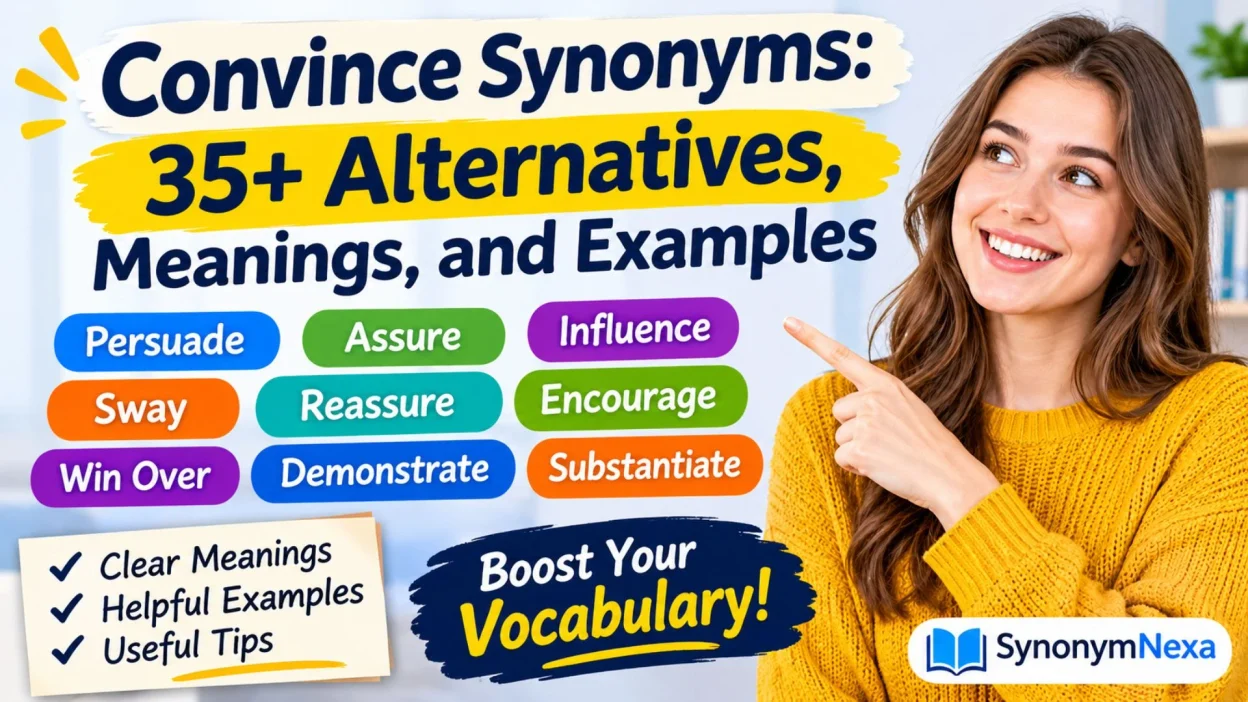
Looking for the best convince synonyms to make your writing clearer and more effective? The word convince means to persuade someone to believe something or agree with an idea. However, several alternatives can express this meaning in different ways. For example, you might use persuade in everyday conversations, assure when giving someone confidence, or influence when describing an effect on someone’s decisions.
Choosing the right synonym depends on your sentence, audience, and intended meaning. Therefore, this guide explores useful alternatives, explains their differences, and provides practical examples. Whether you are writing an email, preparing an essay, or improving your vocabulary, you will find the right word for your situation.
What Does Convince Mean?
The verb convince means to make someone believe that something is true or accept an idea through reasoning, evidence, or explanation.
For instance, imagine that you explain why a particular decision is beneficial. If the other person accepts your explanation, you have convinced them.
The word can also describe changing someone’s opinion. However, convincing someone does not always mean making them take action.
Examples:
- Her explanation convinced me that the plan was worthwhile.
- The teacher convinced the students to reconsider their answers.
- Strong evidence convinced the jury of his innocence.
- I tried to convince my parents that the trip was safe.
In each example, someone changes their belief or opinion because of information, reasoning, or communication.
Best Convince Synonyms and Their Meanings
Several words have meanings similar to convince. Nevertheless, they are not always interchangeable. The following alternatives are especially useful in everyday and professional writing.
| Synonym | Meaning |
|---|---|
| Persuade | Encourage someone to agree or take action |
| Assure | Remove someone’s doubts or fears |
| Influence | Affect someone’s opinions or decisions |
| Sway | Change someone’s opinion or choice |
| Win over | Gain someone’s support or approval |
| Convince | Make someone believe something |
| Reassure | Restore someone’s confidence |
| Encourage | Give someone confidence or motivation |
| Coax | Gently persuade someone |
| Motivate | Inspire someone to act |
| Induce | Lead someone to do something |
| Impress | Create a strong positive opinion |
| Satisfy | Provide enough evidence or explanation |
| Demonstrate | Show something through evidence |
| Prove | Establish that something is true |
Remember: The best choice depends on whether you want to change someone’s belief, remove doubt, or encourage action.
35+ Synonyms for Convince
Here is a broader collection of alternatives. Each word includes a short explanation to help you understand its use.
Common Synonyms
These words work well in everyday conversations and general writing.
- Persuade: Get someone to agree with an idea or take action.
- Influence: Affect how someone thinks or behaves.
- Sway: Change someone’s opinion or decision.
- Assure: Tell someone something confidently to remove doubt.
- Reassure: Help someone feel confident or less worried.
- Encourage: Give someone support or motivation.
- Win over: Gain someone’s trust, support, or approval.
- Coax: Gently persuade someone to do something.
- Motivate: Give someone a reason or desire to act.
- Inspire: Encourage someone through ideas or positive feelings.
Formal Synonyms
These alternatives are useful in academic, business, and professional communication.
- Induce: Lead someone toward a particular action.
- Prevail upon: Successfully persuade someone to do something.
- Convincingly demonstrate: Present clear evidence supporting an idea.
- Substantiate: Support a claim with evidence.
- Corroborate: Confirm a statement using additional evidence.
- Establish: Show that something is true or valid.
- Validate: Confirm that something is reasonable or correct.
- Justify: Provide reasons or evidence supporting a decision.
- Satisfy: Meet someone’s concerns or requirements.
- Convert: Change someone’s beliefs, opinions, or position.
Informal Synonyms
Use these expressions in casual conversations and friendly writing.
- Talk into: Persuade someone to do something.
- Win around: Gradually gain someone’s agreement or support.
- Get through to: Make someone understand your message.
- Bring around: Change someone’s opinion or attitude.
- Nudge: Gently encourage someone toward a choice.
- Sweet-talk: Persuade someone through flattering or charming language.
- Get on board: Gain someone’s agreement or support.
- Talk around: Persuade someone by discussing different reasons.
- Charm: Gain someone’s approval through appealing behavior.
- Appeal to: Attract someone’s interest or support.
Some informal expressions have specific meanings. Therefore, check the sentence before replacing convince with one of them.
Convince vs. Persuade: What’s the Difference?
Convince and persuade are among the closest synonyms. However, they often emphasize different results.
- Convince usually focuses on changing someone’s belief or opinion.
- Persuade often focuses on getting someone to agree or take action.
For example:
- The evidence convinced me that the product was reliable.
- My friend persuaded me to buy the product.
In the first sentence, the person changes their belief. In the second, the person agrees to take action.
When Should You Use Convince?
Use convince when your main goal is to show that someone accepts an idea as true.
Examples:
- The facts convinced her that the story was accurate.
- His explanation convinced us of the benefits.
- Nothing could convince me that the rumor was true.
When Should You Use Persuade?
Use persuade when someone encourages another person to make a decision or perform an action.
Examples:
- She persuaded her brother to join the team.
- The manager persuaded the staff to attend the meeting.
- We persuaded our neighbors to support the project.
Both words are useful. However, choosing the correct one makes your sentence more precise.
Convince Synonyms for Different Situations
Not every synonym works in every situation. In particular, professional writing, friendly conversations, and academic explanations may require different vocabulary.
Synonyms for Professional Writing
In business communication, choose words that sound clear and respectful.
- Demonstrate: Show something using facts or examples.
- Establish: Prove or confirm a point.
- Substantiate: Support a statement with evidence.
- Justify: Explain why a decision is reasonable.
- Validate: Confirm the value or accuracy of something.
- Persuade: Encourage someone to accept a proposal.
Examples:
- The report demonstrates the benefits of the new strategy.
- The research substantiates the company’s claims.
- The manager justified the decision with clear evidence.
Synonyms for Everyday Conversations
For casual communication, simpler words often sound more natural.
- Talk into
- Coax
- Win over
- Encourage
- Reassure
- Bring around
Examples:
- I finally talked my friend into watching the movie.
- She encouraged me to try something new.
- His explanation reassured everyone.
Synonyms for Academic Writing
Academic writing often requires precise words that describe evidence and reasoning.
- Substantiate: Support an argument with evidence.
- Corroborate: Confirm a claim with additional information.
- Demonstrate: Show a point clearly.
- Establish: Provide a basis for accepting a fact.
- Validate: Confirm the accuracy or soundness of an idea.
- Justify: Give logical reasons for a conclusion.
Examples:
- The experiment demonstrates the importance of regular testing.
- Additional studies corroborate the original findings.
- The available evidence supports the researcher’s conclusion.
Example Sentences Using Convince Synonyms
Seeing synonyms in complete sentences makes their meanings easier to understand. Here are practical examples from different situations.
| Synonym | Example Sentence |
|---|---|
| Persuade | I persuaded my friend to attend the event. |
| Assure | She assured me that everything was ready. |
| Influence | His advice influenced my decision. |
| Sway | The discussion swayed their opinion. |
| Reassure | The doctor reassured the worried family. |
| Encourage | My parents encouraged me to apply. |
| Coax | He coaxed his little brother into joining. |
| Motivate | The coach motivated the players to improve. |
| Induce | The offer induced customers to reconsider. |
| Demonstrate | The results demonstrate the value of practice. |
| Substantiate | The documents substantiate her statement. |
| Validate | The research validates the proposed method. |
More Examples in Different Contexts
In personal conversations:
- Her kindness won over the entire group.
- I tried to get through to my friend.
- He brought his parents around to his idea.
In workplace communication:
- The presentation persuaded the team to consider the proposal.
- Clear results justified the additional investment.
- The report established the need for improvement.
Academic writing:
- The findings corroborate the original theory.
- The evidence substantiates the researcher’s argument.
- The study demonstrates a clear relationship between the two factors.
Words Related to Convince That Are Not Exact Synonyms
Some words are closely connected to convince, but they do not always carry the same meaning. Understanding these differences helps prevent awkward sentences.
| Related Word | Meaning | Difference |
|---|---|---|
| Explain | Make something easier to understand | Does not necessarily change someone’s belief |
| Inform | Give someone information | Does not require agreement |
| Suggest | Present an idea for consideration | Does not necessarily persuade |
| Argue | Give reasons supporting or opposing an idea | May not change anyone’s opinion |
| Recommend | Advise someone to consider something | Does not guarantee acceptance |
| Negotiate | Discuss to reach an agreement | Focuses on reaching a mutual decision |
| Prove | Establish that something is true | Focuses on evidence rather than persuasion |
| Debate | Discuss opposing opinions | Does not necessarily produce agreement |
For example, explaining a product’s benefits does not automatically convince someone to buy it. Similarly, recommending a book does not mean the listener accepts your recommendation.
Therefore, choose a word that describes the actual result of your communication.
Antonyms of Convince
An antonym is a word with an opposite or contrasting meaning. Although convince does not have one perfect opposite in every context, several words express resistance, disagreement, or failure to persuade.
| Antonym or Opposing Expression | Meaning |
|---|---|
| Dissuade | Persuade someone not to do something |
| Discourage | Reduce someone’s confidence or desire |
| Deter | Prevent someone from taking action |
| Confuse | Make something difficult to understand |
| Mislead | Cause someone to believe something incorrect |
| Disprove | Show that a claim is false |
| Contradict | State the opposite of a claim |
| Refute | Prove that an argument is wrong |
| Disagree | Have a different opinion |
| Reject | Refuse to accept an idea |
Examples of Opposing Words
- I tried to convince him, but he disagreed.
- Her warning dissuaded me from making that decision.
- The new evidence disproved the original claim.
- Nothing could deter them from completing the project.
Notice that dissuade is especially useful when discussing the opposite of persuading someone to take action.
How to Choose the Right Synonym for Convince
Choosing the correct alternative depends on your intended message. First, identify whether you want to describe a change in belief, a decision, or someone’s confidence.
Consider Your Intended Meaning
- Use persuade when someone agrees to take action.
- Use assure when you want to remove doubt.
- Use reassure when someone feels worried or uncertain.
- Use influence when something affects a person’s thinking.
- Use demonstrate when facts clearly show a point.
- Use substantiate when evidence supports a claim.
- Use coax when someone needs gentle encouragement.
- Use sway when someone’s opinion or decision changes.
Match the Word to Your Audience
Formal writing benefits from precise vocabulary. For example, substantiate works well in research papers, while talk into sounds more natural in casual conversations.
Moreover, simple words often communicate ideas more clearly. You do not need complicated vocabulary when persuade or encourage expresses your meaning perfectly.
Check the Sentence Before Replacing the Word
Read your sentence after choosing a synonym. Then check whether the original meaning remains accurate.
For example:
- Original: I convinced her to attend the meeting.
- Better alternative: I persuaded her to attend the meeting.
However, replacing convinced with assured would change the meaning. Therefore, always consider the context rather than choosing a word only because it appears in a synonym list.
FAQ Section
What Is the Best Synonym for Convince?
Persuade is one of the closest and most common synonyms for convince. However, assure, influence, sway, and reassure may work better in specific situations.
What Is Another Word for Convince in Formal Writing?
Formal alternatives include substantiate, demonstrate, establish, validate, and justify. Choose the word that accurately describes your intended meaning.
Are Convince and Persuade the Same?
They have similar meanings, but their emphasis can differ. Convince generally focuses on changing someone’s belief, while persuade often focuses on encouraging an action.
What Is the Opposite of Convince?
Dissuade is a useful opposite when discussing persuasion toward an action. Other contrasting words include disagree, reject, refute, and disprove.
What Is a Simple Word for Convince?
Persuade is a simple and widely understood alternative. You can also use assure, encourage, or influence, depending on the sentence.
Can Influence Be Used Instead of Convince?
Sometimes. Influence means affecting someone’s thoughts, feelings, or decisions. However, it does not necessarily mean that the person fully accepts an idea.
Conclusion
Learning useful convince synonyms can make your writing more natural, expressive, and precise. Words such as persuade, assure, influence, sway, and reassure offer different ways to communicate similar ideas. However, each alternative has its own meaning and appropriate context. For the best results, consider your audience and the message you want to express before choosing a replacement. With regular practice, you can build stronger vocabulary and communicate your ideas more confidently. Explore more vocabulary guides on SynonymNexa.