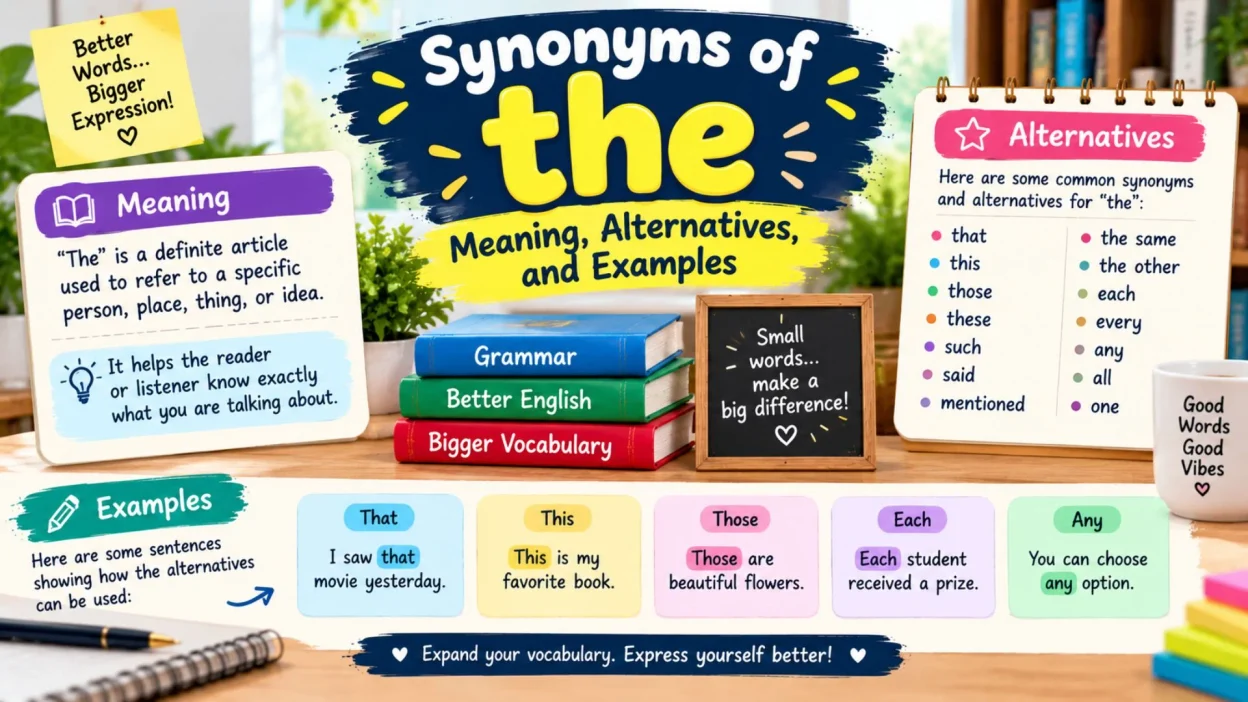
The synonyms of the is a common vocabulary search, but the word the is different from most English words. It is a definite article used before a noun to identify a specific person, place, thing, or idea. Unlike words such as happy or beautiful, the does not have direct synonyms that work in every sentence. However, depending on the context, you can sometimes replace it with words such as this, that, these, those, or my.
Understanding these alternatives can help you write more clearly and avoid unnecessary repetition. However, each word has a different purpose, so you cannot simply replace the everywhere. In this guide, you will learn what the means, which words can sometimes replace it, and how to use those alternatives correctly in everyday English, academic writing, and professional communication.
What Does “The” Mean?
The word the is known as the definite article in English grammar. It tells readers or listeners that a noun refers to something specific or already known.
For example, compare these two sentences:
- I saw a dog in the park.
- I saw the dog in the park.
In the first sentence, a dog refers to any dog. In the second sentence, the dog refers to a particular dog that the speaker expects the listener to identify.
Additionally, we use the when the context makes a noun clear. For instance, if someone says, “Please close the door,” the listener usually knows which door is meant.
When Do We Use “The”?
The definite article appears in several common situations:
- Specific objects: Please pass me the book.
- Previously mentioned things: I bought a jacket. The jacket was expensive.
- Unique things: The sun rises in the east.
- Superlatives: She is the tallest student in the class.
- Certain geographical names: The Nile, the Pacific Ocean, and the United States.
Therefore, understanding how the works is essential before choosing an alternative.
Are There Direct Synonyms of “The”?
Strictly speaking, the does not have true synonyms because it performs a grammatical function rather than expressing a descriptive meaning. Still, several words can replace it in particular sentences.
For example, consider “the house.” Depending on the context, you might write this house, that house, or my house. However, these expressions do not mean exactly the same thing.
- This: Identifies something near the speaker or closely connected to the current discussion.
- That: Identifies something farther away or previously mentioned.
- These: Refers to multiple things near the speaker.
- Those: Refers to multiple things farther away or already identified.
- My: Shows possession or a personal relationship.
- Your: Shows that something belongs or relates to the person being addressed.
These words are not interchangeable in every situation. Instead, choose the alternative that communicates the intended meaning.
10 Words That Can Sometimes Replace “The”
The following table highlights words that may replace the in certain contexts. Remember that these are contextual alternatives, not exact synonyms.
| Alternative | Main purpose | Example |
|---|---|---|
| This | Identifies something nearby or current | This book is useful. |
| That | Identifies something farther away or known | That building is tall. |
| These | Refers to nearby plural items | These flowers are fresh. |
| Those | Refers to specific plural items | Those shoes look comfortable. |
| My | Shows personal possession | My car needs repairs. |
| Your | Shows possession by the listener | Your answer is correct. |
| His | Shows possession by a male person | His phone is ringing. |
| Her | Shows possession by a female person | Her dress is beautiful. |
| Our | Shows a shared relationship or possession | Our team won. |
| Their | Shows possession by other people | Their house is nearby. |
How to Choose the Right Alternative
First, consider whether you need to identify something by location. In that case, this, that, these, or those may be suitable.
Next, consider whether you need to show ownership. Words such as my, your, his, her, our, and their can work instead.
However, changing the to one of these words may alter the sentence’s meaning. For example, “the car” identifies a particular car, while “my car” specifically identifies a car belonging to the speaker.
Examples of “The” and Its Contextual Alternatives
Examples make it easier to understand how these words work in everyday English. The following comparisons show when an alternative is appropriate.
Using “This” Instead of “The”
Use this when you want to point out something nearby or emphasize a particular item.
- Original: The notebook is on my desk.
- Alternative: This notebook is on my desk.
Both sentences can be correct. However, this notebook places more emphasis on the particular notebook being discussed.
For example, a teacher might say, “This chapter explains the main concept.” The word this connects the chapter to the current discussion.
Using “That” Instead of “The”
The word that can identify something at a distance or refer to something already mentioned.
- Original: The restaurant serves excellent food.
- Alternative: That restaurant serves excellent food.
The second sentence may suggest that the speaker is pointing to a restaurant or referring to one known to the listener.
Similarly, someone might say, “That idea could solve our problem.” Here, that points back to a previously discussed idea.
Using “These” or “Those”
Use these and those with plural nouns.
- Original: The cookies taste delicious.
- Alternative: These cookies taste delicious.
- Alternative: Those cookies taste delicious.
The best choice depends on the intended meaning. These cookies usually refers to cookies nearby, while those cookies can refer to cookies farther away or already identified.
Using Possessive Words
Possessive words can replace a noun phrase beginning with the when ownership or association matters.
- Original: The phone is on the table.
- Alternative: My phone is on the table.
The alternative is appropriate only if the phone belongs to the speaker. Therefore, it should not be used when ownership is unknown or irrelevant.
The Difference Between “The,” “A,” and “An”
Although a and an are articles like the, they are not synonyms. Each article communicates a different level of specificity.
| Article | Usage | Example |
|---|---|---|
| The | Refers to a specific or identifiable noun | The teacher is here. |
| A | Refers to a nonspecific singular noun beginning with a consonant sound | A teacher called me. |
| An | Refers to a nonspecific singular noun beginning with a vowel sound | An artist visited us. |
When Should You Use “A” or “An”?
Use a or an when introducing a singular countable noun that is not yet identified as a specific one.
For example, “I saw a bird in the garden.” The bird is being introduced for the first time.
Next, you can use the when referring to that same bird again: “The bird was sitting on a branch.”
This pattern is common in English writing. First, introduce something with a or an. Then, use the when the reader knows which thing you mean.
Common Phrases Containing “The”
The word the appears in many familiar English expressions. In most of these phrases, removing or replacing it changes the grammar or meaning.
Everyday Expressions
- In the morning: Refers to the morning period.
- At the moment: Means right now.
- On the other hand: Introduces a contrasting point.
- At the same time: Describes two events happening together.
- In the end: Refers to the final result.
- By the way: Introduces an additional or related comment.
For example, you would normally say, “I exercise in the morning,” rather than “I exercise in morning.” The article is part of the standard expression.
Academic and Professional Expressions
The definite article also appears in formal writing.
- The following: Introduces information that comes next.
- The results: Refers to particular findings.
- The main reason: Identifies a specific reason.
- The conclusion: Refers to the final section or judgment.
- The research: Refers to particular research identified by the context.
However, English sometimes omits the in general statements. For example, “Research takes time” is natural when discussing research in general, while “The research took six months” refers to a specific project.
When Should You Avoid Replacing “The”?
Although contextual alternatives can improve variety, replacing the simply to avoid repetition can make writing confusing.
Do Not Replace It Without Checking the Meaning
Consider this sentence:
“The manager spoke to the employee.”
Changing it to “This manager spoke to the employee” adds emphasis or suggests a particular manager. Likewise, “My manager spoke to the employee” introduces a personal relationship that was not present in the original sentence.
Therefore, keep the when it is the most accurate choice.
Avoid Incorrect Article Usage
Some nouns require the in specific contexts, while others do not use an article in general statements.
For example:
- Correct: The moon looks bright tonight.
- Correct: Water is essential for life.
- Correct: The water in this bottle is cold.
- Incorrect in standard English: Moon looks bright tonight.
The correct choice depends on whether the noun is specific, general, countable, or part of a fixed expression.
Focus on Clarity Rather Than Variety
In good writing, repeating the is not necessarily a problem. It is one of the most common words in English and often makes sentences easier to understand.
Instead of forcing a replacement, improve variety by changing sentence structure, removing unnecessary words, or choosing more precise nouns when appropriate.
How to Use “The” Correctly in Sentences
The following practical tips can help you use the definite article confidently.
- Identify the noun: Decide whether you are referring to a specific person, place, or thing.
- Check the context: If the reader already knows what you mean, the may be appropriate.
- Use demonstratives carefully: Choose this or that when location or emphasis matters.
- Use possessives accurately: Select my, your, his, her, our, or their only when the relationship is correct.
- Learn fixed expressions: Memorize common phrases such as in the morning and at the moment.
- Read your sentence aloud: If a replacement changes the meaning, keep the original article.
Ultimately, grammar is about communicating the right meaning. A natural sentence is more effective than one that uses unnecessary alternatives.
FAQ Section
What are the synonyms of the?
There are no exact synonyms for the because it is a definite article. However, words such as this, that, these, and those can replace it in certain contexts.
Can I use “this” instead of “the”?
Yes, but only when this fits the meaning. For example, “the book” can become “this book” when you want to identify or emphasize a particular book, often one nearby.
Are “the,” “a,” and “an” synonyms?
No. All three are articles, but they serve different purposes. The identifies a specific or identifiable noun, while a and an generally introduce a nonspecific singular countable noun.
How can I avoid repeating “the” in writing?
You do not need to avoid every repetition. Instead, vary your sentence structure and use alternatives only when they preserve the intended meaning. Clear grammar should come before stylistic variety.
Is “that” a synonym for “the”?
Not exactly. That is a demonstrative determiner or pronoun, while the is a definite article. They can appear in similar sentence positions, but their meanings differ.
Why is “the” important in English?
The word the helps identify specific nouns and makes relationships between ideas clearer. Without it, many sentences would sound unnatural or become grammatically incorrect.
Conclusion
The synonyms of the are better understood as contextual alternatives rather than exact replacements. Words such as this, that, these, those, and possessive determiners can sometimes replace the, depending on the sentence. However, each alternative adds a different meaning, so choosing the right word matters more than avoiding repetition. In summary, use the when referring to a specific or identifiable noun, and select another word only when it communicates your intended meaning accurately. For more practical vocabulary explanations, grammar tips, and word comparisons, explore more vocabulary guides on SynonymNexa.