
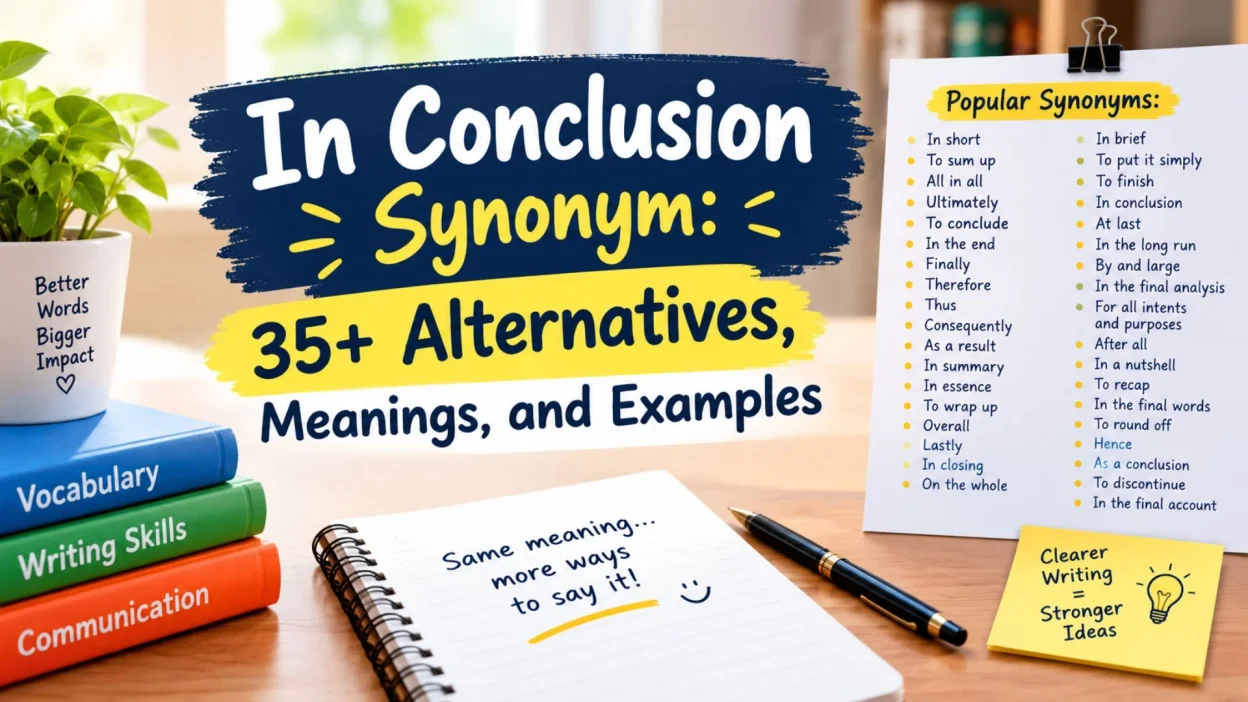
Looking for an in conclusion synonym that makes your writing sound more natural, professional, and engaging? The phrase “in conclusion” is commonly used to summarize ideas, wrap up essays, and introduce final thoughts. However, repeating it in every paragraph or assignment can make your writing feel predictable. Choosing the right alternative helps you communicate your message clearly while maintaining a smooth flow.
Whether you are writing an academic essay, a business report, a presentation, an email, or a blog post, several expressions can help you introduce a final point. Options such as to summarize, in summary, ultimately, to conclude, and all in all serve different purposes depending on the context.
In this guide, you will discover more than 35 alternatives to “in conclusion,” along with their meanings, tones, and example sentences. You will also learn which expressions work best in formal writing, everyday conversations, and professional communication. By understanding the differences between these transition phrases, you can avoid repetition, strengthen your conclusions, and make your writing easier to follow.
⚡ Quick Answer: What Is Another Word for In Conclusion?
The best synonyms for “in conclusion” include to conclude, in summary, to summarize, ultimately, all in all, to sum up, overall, and in closing. These expressions introduce a final thought, summarize important information, or communicate the main takeaway. The most suitable alternative depends on your audience, writing style, and intended meaning.
📝 Best Synonyms for In Conclusion
The phrase “in conclusion” signals that a discussion, argument, or piece of writing is reaching its end. However, different alternatives emphasize different things, such as summarizing information, presenting a final judgment, or closing a conversation.
Here are some widely useful alternatives and their meanings.
1. To Conclude
“To conclude” is a direct and professional alternative that introduces the final part of an argument, speech, or discussion.
Example: To conclude, regular exercise improves physical health and supports emotional well-being.
2. In Summary
“In summary” introduces a brief overview of the main points. It works especially well in academic writing, reports, and presentations.
Example: In summary, the research highlights the importance of early education.
3. To Summarize
“To summarize” signals that you are about to restate the essential information without repeating every detail.
Example: To summarize, the new strategy reduces expenses while improving productivity.
4. Ultimately
“Ultimately” emphasizes the final result, most important consideration, or main outcome of a discussion.
Example: Ultimately, the success of the project depends on effective teamwork.
5. All in All
“All in all” provides a general assessment of a situation. It sounds natural in conversations, reviews, and informal writing.
Example: All in all, the trip was enjoyable despite a few unexpected delays.
6. To Sum Up
“To sum up” introduces a concise summary of the information discussed. It is suitable for presentations, articles, and everyday communication.
Example: To sum up, preparation and consistency are essential for success.
7. Overall
“Overall” presents a broad judgment or general impression after considering several details.
Example: Overall, the training program helped employees develop valuable skills.
8. In Closing
“In closing” signals the final remarks of a speech, presentation, letter, or formal discussion.
Example: In closing, I would like to thank everyone who contributed to this initiative.
9. In Short
“In short” introduces a brief statement that captures the central point of a longer explanation.
Example: In short, the proposal offers a practical solution to the problem.
10. In Brief
“In brief” introduces a condensed explanation, especially when the reader needs the essential facts quickly.
Example: In brief, the company plans to expand its services next year.
🎓 Formal Synonyms for In Conclusion
Formal alternatives are particularly useful for research papers, university assignments, business reports, professional presentations, and official documents. They help maintain a polished tone without making your writing unnecessarily complicated.
Consider these expressions when you want to end a discussion professionally.
- In summary: Restates the main points in a concise form.
- To conclude: Introduces the final section of an argument or report.
- In closing: Signals final remarks in a formal address.
- On balance: Presents a judgment after weighing different considerations.
- Taken together: Shows how several pieces of information support a broader conclusion.
- In light of these findings: Connects a conclusion to evidence or research results.
- Based on the evidence: Introduces a conclusion supported by available facts.
- From this perspective: Presents a final interpretation from a particular viewpoint.
- The evidence suggests: Communicates a reasoned conclusion without overstating certainty.
- In consideration of these points: Connects a final judgment to previously discussed factors.
Example:
Original: In conclusion, the findings show that sleep affects academic performance.
Revised: Taken together, the findings suggest that sleep plays an important role in academic performance.
The revised sentence connects multiple findings and presents a broader interpretation. In academic writing, however, use phrases such as “the evidence suggests” when the results support a qualified conclusion rather than a definitive claim.
💬 Informal and Conversational Alternatives
Not every conclusion needs to sound formal. In casual conversations, blog posts, personal messages, and informal presentations, simpler expressions often sound more natural.
Here are some conversational alternatives to “in conclusion.”
- All in all: Gives an overall opinion about an experience.
- Long story short: Reduces a longer explanation to its main point.
- At the end of the day: Emphasizes the most important consideration.
- To put it simply: Introduces an easier explanation of a complicated idea.
- Basically: Presents the essential meaning in straightforward language.
- When all is said and done: Emphasizes the final judgment after considering everything.
- The bottom line is: Highlights the most important result or message.
- In a nutshell: Condenses a complicated subject into a short explanation.
- So, overall: Connects a final judgment to the discussion.
- All things considered: Introduces a judgment that takes several factors into account.
Examples:
- All in all, we had a fantastic weekend.
- Long story short, we found a better solution.
- At the end of the day, your health matters most.
- The bottom line is that we need a realistic budget.
- In a nutshell, the plan is simple and affordable.
Keep your audience in mind when using conversational alternatives. “Long story short” and “in a nutshell” may sound too casual in a formal research paper, while “in summary” would usually fit more comfortably.
📚 Comprehensive Table of 40 In Conclusion Synonyms
The following table compares useful alternatives according to their meanings, tones, and practical applications. Some expressions are direct substitutes, while others work only when the sentence calls for a particular emphasis.
| Synonym or Alternative | Meaning | Tone or Usage | Example Sentence |
|---|---|---|---|
| To conclude | Introduces a final statement | Formal | To conclude, the evidence supports the proposal. |
| In summary | Gives the main points briefly | Formal | In summary, the results were encouraging. |
| To summarize | Restates essential information | Neutral | To summarize, three changes are necessary. |
| Ultimately | Emphasizes the final outcome | Neutral | Ultimately, patience made the difference. |
| All in all | Gives an overall assessment | Informal | All in all, the event was successful. |
| To sum up | Condenses the main message | Neutral | To sum up, preparation is essential. |
| Overall | Expresses a general judgment | Neutral | Overall, the experience was positive. |
| In closing | Introduces final remarks | Formal | In closing, thank you for your support. |
| In short | States the essential point | Neutral | In short, the approach works. |
| In brief | Presents a concise explanation | Formal | In brief, the policy improves access. |
| On balance | Weighs advantages and disadvantages | Formal | On balance, the benefits outweigh the costs. |
| Taken together | Combines several points or findings | Academic | Taken together, the results support our hypothesis. |
| In the final analysis | Presents a considered final judgment | Formal | In the final analysis, trust remains essential. |
| All things considered | Considers several relevant factors | Neutral | All things considered, we made the right choice. |
| When all is said and done | Expresses a final overall judgment | Conversational | When all is said and done, family comes first. |
| At the end of the day | Highlights the ultimate consideration | Conversational | At the end of the day, results matter. |
| The bottom line is | Identifies the key takeaway | Conversational | The bottom line is that costs must fall. |
| In a nutshell | Condenses the main idea | Informal | In a nutshell, the process saves time. |
| Long story short | Shortens a longer account | Informal | Long story short, we reached an agreement. |
| Basically | States the essential meaning | Informal | Basically, the system needs an update. |
| In essence | Expresses the core meaning | Neutral | In essence, the proposal encourages cooperation. |
| In other words | Restates an idea differently | Neutral | In other words, everyone benefits. |
| Put simply | Makes an explanation easier | Neutral | Put simply, practice builds confidence. |
| To put it simply | Gives an accessible explanation | Neutral | To put it simply, the plan is affordable. |
| In practical terms | Explains the real-world implication | Professional | In practical terms, the change reduces delays. |
| The key takeaway is | Highlights the most important lesson | Professional | The key takeaway is that planning matters. |
| The main point is | Identifies the central message | Neutral | The main point is that communication works. |
| In light of these findings | Draws on research or results | Academic | In light of these findings, further testing is warranted. |
| Based on the evidence | Connects a judgment to evidence | Academic | Based on the evidence, the treatment requires further study. |
| The evidence suggests | Expresses an evidence-based inference | Academic | The evidence suggests that demand is increasing. |
| This demonstrates that | Connects evidence to a supported point | Academic | This demonstrates that early preparation is valuable. |
| For these reasons | Connects a decision to stated reasons | Formal | For these reasons, the policy should be revised. |
| Therefore | Indicates a logical result | Formal | Therefore, the next stage can begin. |
| Thus | Introduces a result or inference | Formal | Thus, the findings support further investigation. |
| Consequently | Emphasizes a resulting outcome | Formal | Consequently, the company changed its approach. |
| Accordingly | Shows a result or appropriate response | Formal | Accordingly, the schedule was adjusted. |
| In view of this | Draws a conclusion from a circumstance | Formal | In view of this, the deadline was extended. |
| On the whole | Gives a general assessment | Neutral | On the whole, the plan was effective. |
| In the end | Refers to the final outcome | Neutral | In the end, both teams agreed. |
| To bring it all together | Connects the main ideas | Conversational | To bring it all together, teamwork drives progress. |
Important distinction: Not every expression in this table is a direct synonym. Words such as “therefore,” “thus,” and “consequently” emphasize logical results, while “in summary” and “to sum up” explicitly introduce a summary. Choose the alternative that matches the relationship between your ideas.
🎯 Best Alternatives for Different Writing Situations
The most suitable synonym depends on where and why you are writing. A university essay, a workplace email, and a friendly conversation each have different expectations.
| Situation | Recommended Alternative | Why It Fits | Example |
|---|---|---|---|
| Academic essay | In summary | Clearly summarizes the argument | In summary, the findings support the original hypothesis. |
| Research paper | Taken together | Connects multiple findings | Taken together, the results indicate a consistent pattern. |
| Business report | Overall | Provides a broad assessment | Overall, quarterly performance improved. |
| Professional email | In closing | Introduces final remarks | In closing, thank you for reviewing the proposal. |
| Formal speech | To conclude | Signals the final part of a speech | To conclude, collaboration remains our greatest strength. |
| Casual conversation | All in all | Sounds natural and relaxed | All in all, it was a good decision. |
| Blog post | The key takeaway is | Highlights a useful lesson | The key takeaway is that small changes can help. |
| Persuasive writing | For these reasons | Connects reasons to a position | For these reasons, the proposal deserves consideration. |
| Evidence-based argument | The evidence suggests | Avoids overstating a finding | The evidence suggests that the approach is effective. |
| Short explanation | In short | Gets directly to the point | In short, we need more time. |
| Personal reflection | In the end | Emphasizes the eventual outcome | In the end, the experience taught me patience. |
| Product review | On the whole | Gives a balanced judgment | On the whole, the device performs well. |
These alternatives are not always interchangeable. For example, “in summary” tells readers that a recap is coming, whereas “therefore” indicates that the next statement follows logically from what came before.
✍️ Example Sentences Using In Conclusion Synonyms
Seeing these alternatives in complete sentences makes it easier to understand their differences. The following examples demonstrate how to use them in academic, professional, conversational, and creative writing.
Academic Writing
- In summary, the research identifies three major factors affecting student achievement.
- Taken together, the findings suggest that early intervention can improve outcomes.
- On balance, the available evidence supports the proposed explanation.
- In light of these findings, additional research is needed.
- To conclude, the study highlights the value of consistent evaluation.
Professional Communication
- In closing, I appreciate your time and consideration.
- Overall, the project met its primary objectives.
- The key takeaway is that clear communication reduces misunderstandings.
- For these reasons, we recommend revising the current schedule.
- Accordingly, the team will begin the next phase on Monday.
Everyday Conversations
- All in all, we had a wonderful time together.
- Long story short, I found the information I needed.
- At the end of the day, everyone wants to feel appreciated.
- In a nutshell, the restaurant offers great food at reasonable prices.
- The bottom line is that we need to make a decision.
Creative and Persuasive Writing
- Ultimately, courage means moving forward despite uncertainty.
- In essence, the story explores the importance of belonging.
- When all is said and done, kindness leaves a lasting impression.
- In the final analysis, freedom requires responsibility.
- To bring it all together, every small action contributes to meaningful change.
Notice how each expression serves a slightly different purpose. “Ultimately” emphasizes the final significance of an idea, while “in essence” focuses on its fundamental meaning. Choosing carefully makes your writing more precise.
🔍 How to Choose the Right In Conclusion Synonym
Choosing an alternative involves more than finding a phrase with a similar dictionary meaning. You must also consider what your sentence is doing and how your readers will interpret it.
Consider Your Intended Meaning
First, decide whether you want to summarize information, present a final judgment, or explain a result.
Use “in summary” when you are reviewing key points. Choose “overall” when evaluating the general quality of something. Use “therefore” when the next statement follows logically from previous information.
For example:
- Summary: In summary, the project met its three main goals.
- Evaluation: Overall, the project was successful.
- Logical result: Therefore, the team can proceed to the next phase.
Although these sentences discuss the same project, each transition performs a different function.
Match the Formality to Your Audience
Academic papers and professional reports generally benefit from expressions such as “to conclude,” “in summary,” and “taken together.”
Conversational writing allows more relaxed options, including “all in all,” “in a nutshell,” and “the bottom line is.”
For instance, “Long story short, we solved the issue” sounds natural in a casual conversation. However, “In summary, the issue has been resolved” is more appropriate for a formal business update.
Pay Attention to Tone
Some alternatives communicate confidence, while others sound reflective or cautious.
“Ultimately” often emphasizes the most important outcome. “On balance” suggests that you have considered competing factors. “The evidence suggests” communicates a measured interpretation rather than absolute certainty.
When discussing research or complex issues, choose wording that reflects the strength of the available evidence.
Check Grammar and Sentence Structure
A transition must fit naturally into the sentence that follows it.
For example:
- Correct: “Therefore, the committee approved the proposal.”
- Correct: “In summary, the committee approved the proposal after reviewing the evidence.”
- Incorrect in a standard formal sentence: “In conclusion, because the committee approved the proposal.”
The final example creates an incomplete construction if nothing follows the subordinate clause. The problem is the sentence structure, not the phrase itself.
Avoid Repetition Without Sacrificing Clarity
Replacing every occurrence of “in conclusion” with a different phrase is not always necessary. Sometimes the clearest option is to remove the transition entirely.
Instead of writing, “In conclusion, the results were positive,” you could simply write, “The results were positive.”
Use a transition when it helps readers understand the relationship between ideas. Otherwise, a direct statement may be more effective.
⚠️ Common Mistakes When Using Conclusion Synonyms
Even familiar transition words can create confusion when writers treat them as interchangeable. Avoid these common mistakes to keep your writing accurate and natural.
1. Using “Therefore” as a Simple Summary
“Therefore” signals a logical consequence, not merely a recap.
Less suitable: “Therefore, the report discussed three departments.”
Better: “In summary, the report discussed three departments.”
Use “therefore” when the second statement follows from the first.
2. Confusing “Ultimately” With “In Summary”
“Ultimately” emphasizes a final result or underlying consideration. “In summary” introduces a condensed account of previously discussed information.
Example:
- “Ultimately, customer satisfaction determines the company’s long-term success.”
- “In summary, the report covers customer feedback, service quality, and response times.”
Both phrases can appear near the end of a document, but they do different jobs.
3. Using Casual Expressions in Formal Essays
Phrases such as “long story short,” “in a nutshell,” and “the bottom line is” may sound too conversational in academic writing.
Instead, choose “in summary,” “to conclude,” or “taken together” when these expressions accurately reflect your intended meaning.
4. Repeating the Same Transition Too Often
Starting every concluding paragraph with “in conclusion” can make your writing repetitive. However, using a different transition in every paragraph can feel equally unnatural.
Vary your sentence structure and use transitions only when they help the reader follow your reasoning.
5. Assuming Every Alternative Belongs at the End
Words such as “therefore,” “thus,” and “consequently” can appear in the middle of an argument whenever a logical result is introduced. They do not automatically indicate that the entire article or discussion is ending.
Choose the phrase according to the sentence’s purpose rather than its position on the page.
❓ Frequently Asked Questions
What is the best synonym for “in conclusion”?
“To conclude,” “in summary,” and “to sum up” are useful alternatives. “In summary” works well when reviewing key points, while “to conclude” is suitable for introducing a final statement. The best choice depends on whether you are summarizing information, presenting a judgment, or ending an argument.
What is a formal way to say “in conclusion”?
Formal alternatives include “to conclude,” “in summary,” “taken together,” “on balance,” and “in the final analysis.” Academic writers can also use “in light of these findings” when connecting a final interpretation to research results.
What is an informal synonym for “in conclusion”?
“All in all,” “in a nutshell,” “long story short,” and “the bottom line is” are common informal alternatives. They work well in everyday conversations, personal writing, and casual blog posts, although some may sound too relaxed in formal academic assignments.
Can I use “ultimately” instead of “in conclusion”?
Yes, when you want to emphasize the final outcome, most important factor, or underlying result. However, “ultimately” does not always introduce a summary. Use “in summary” when your main purpose is to recap the important points of a discussion.
What can I use instead of “in conclusion” in an essay?
For an essay, consider “in summary,” “to conclude,” “taken together,” or “on balance.” Choose “taken together” when combining several arguments or findings, and use “on balance” when presenting a judgment after considering different perspectives.
Is “therefore” the same as “in conclusion”?
No. “Therefore” indicates a logical result or consequence, while “in conclusion” signals a final statement or summary. For example, “Therefore, the proposal was approved” expresses a result, whereas “In summary, the proposal addressed three major concerns” recaps information.
What is another way to say “in conclusion” in a presentation?
“To conclude,” “in closing,” and “to sum up” are suitable for presentations. “In closing” is especially useful before final remarks or acknowledgments, while “to sum up” works when briefly reviewing the main points before ending.
How can I avoid saying “in conclusion” repeatedly?
Vary your transitions according to their purpose. Use “in summary” for a recap, “overall” for a general assessment, and “ultimately” for the final outcome. You can also begin with your main takeaway directly, without adding a transition when it is unnecessary.
Conclusion
Choosing the right in conclusion synonym helps you write more clearly, avoid repetitive transitions, and communicate your final message effectively. Expressions such as “in summary,” “to conclude,” and “to sum up” are useful for reviewing key points, while “ultimately” emphasizes the final outcome and “all in all” suits conversational writing. More formal alternatives, including “taken together” and “on balance,” help communicate thoughtful judgments in academic and professional contexts. Before choosing a phrase, consider your meaning, audience, tone, and sentence structure. The goal is not simply to replace familiar words but to make every transition meaningful and natural.