
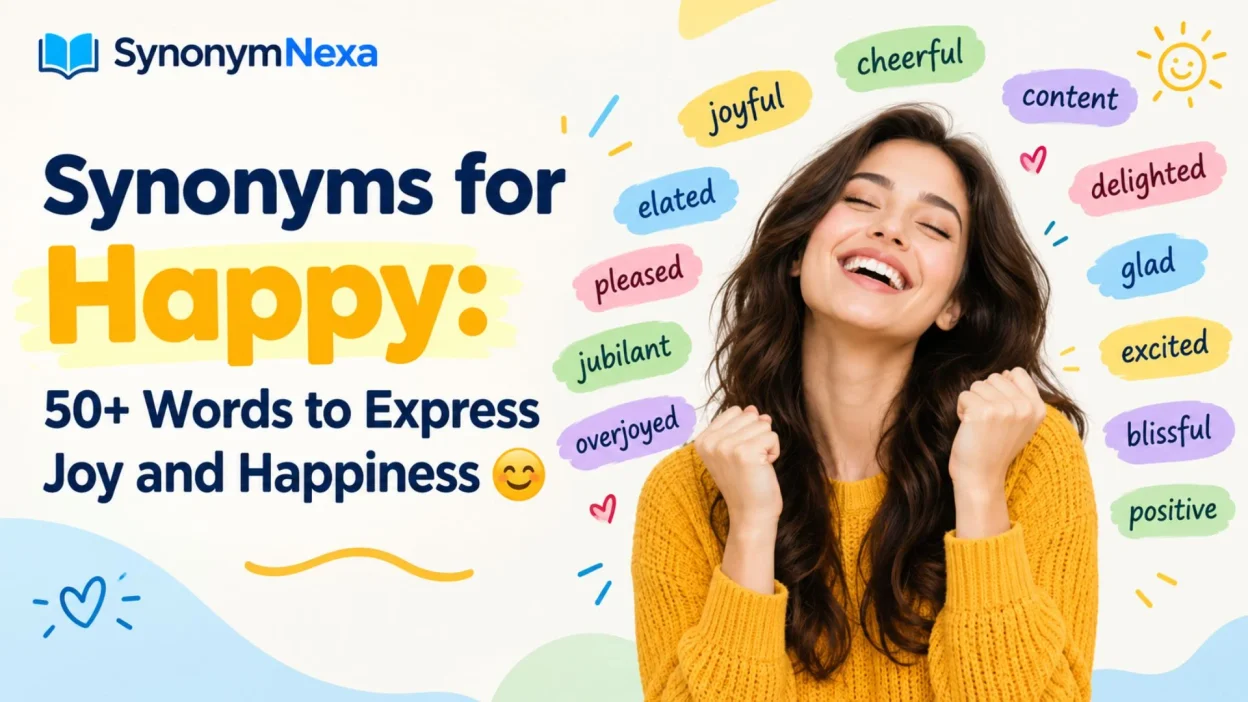
Finding the right synonyms for happy can make your writing more interesting, expressive, and natural. Although happy is a simple and familiar word, it does not always capture the exact feeling you want to describe. For example, you might feel delighted after receiving good news, thrilled before an exciting event, or content with the way your life is going. Each word expresses happiness in a slightly different way.
In this guide, you will discover more than 50 synonyms for happy, along with their meanings, example sentences, and differences in tone. Additionally, you will learn which words work best in everyday conversations, professional writing, creative stories, and academic assignments. Whether you are improving your vocabulary or searching for a more powerful word, these alternatives will help you express your feelings with greater precision.
What Does Happy Mean?
The word happy describes a feeling of pleasure, satisfaction, joy, or general well-being. People often feel happy when something good happens, when they spend time with loved ones, or when they achieve an important goal.
However, happiness does not always look the same. Sometimes, it is a quiet feeling of peace. At other times, it is an exciting burst of joy that makes you smile, laugh, or celebrate.
For example:
- I feel happy when I spend time with my family.
- She was happy to hear that she passed her exam.
- They felt happy after completing their project.
- He seemed happy with his new job.
Although these sentences use the same word, each situation involves a slightly different kind of happiness. Therefore, choosing a more specific synonym can make your message clearer and more engaging.
50+ Synonyms for Happy With Meanings
There are many alternatives to happy, but some express stronger emotions than others. The following words will help you choose an appropriate synonym for different situations.
Common Synonyms for Happy
These everyday alternatives work well in conversations, messages, and general writing.
| Synonym | Meaning | Example Sentence |
|---|---|---|
| Glad | Pleased about something | I’m glad you came to visit. |
| Pleased | Feeling satisfaction or approval | She was pleased with her results. |
| Cheerful | Showing a positive mood | He greeted everyone with a cheerful smile. |
| Joyful | Feeling or expressing great joy | It was a joyful family gathering. |
| Delighted | Extremely pleased | We were delighted to see our friends. |
| Content | Satisfied with what you have | She felt content with her simple life. |
| Satisfied | Happy because something meets expectations | He was satisfied with his progress. |
| Merry | Cheerful and lively | The children enjoyed a merry celebration. |
| Jolly | Happy, friendly, and full of energy | Our jolly neighbor always makes us laugh. |
| Upbeat | Positive and optimistic | She remained upbeat despite the challenges. |
These words are not always interchangeable. For instance, glad often describes a reaction to good news, whereas content suggests a deeper sense of satisfaction. Similarly, cheerful usually describes someone’s general mood or outward behavior.
Strong Synonyms for Happy
When ordinary words do not express enough excitement, choose a stronger alternative. These synonyms are especially useful when describing wonderful news, major achievements, or memorable occasions.
| Synonym | Meaning | Example Sentence |
|---|---|---|
| Ecstatic | Overwhelmingly happy | She was ecstatic about winning the competition. |
| Elated | Extremely joyful and excited | He felt elated after getting his dream job. |
| Thrilled | Very excited and pleased | I’m thrilled to hear your good news. |
| Overjoyed | Filled with intense happiness | Her parents were overjoyed at her graduation. |
| Euphoric | Experiencing intense happiness or excitement | The team felt euphoric after the victory. |
| Exhilarated | Happy and energized by excitement | He felt exhilarated after the adventure. |
| Jubilant | Showing great happiness after success | The jubilant fans celebrated the win. |
| Blissful | Experiencing peaceful, complete happiness | They enjoyed a blissful afternoon together. |
| Rapturous | Expressing overwhelming delight | The audience gave the performers a rapturous welcome. |
| Exuberant | Full of energetic enthusiasm | The exuberant children ran into the garden. |
For example, thrilled works well for exciting personal news, while jubilant often describes people celebrating a victory. Meanwhile, blissful is better suited to peaceful moments than noisy celebrations.
Positive and Cheerful Words Similar to Happy
Sometimes, you want to describe someone who has a positive personality rather than a temporary feeling. In that case, words related to cheerfulness, optimism, and enthusiasm may be more suitable.
Synonyms for a Cheerful Personality
- Sunny: Naturally bright and cheerful. Example: Her sunny personality makes people feel welcome.
- Buoyant: Cheerful and able to recover from difficulties. Example: He stayed buoyant during a difficult week.
- Lively: Full of energy and activity. Example: The lively group made the party enjoyable.
- Lighthearted: Free from serious worry. Example: We had a lighthearted conversation after dinner.
- Mirthful: Full of amusement and laughter. Example: His mirthful expression made everyone smile.
- Sprightly: Energetic and cheerful. Example: The sprightly performer danced across the stage.
- Vivacious: Attractively lively and animated. Example: Her vivacious personality stood out at the event.
- Optimistic: Expecting positive outcomes. Example: She remained optimistic about her future.
- Positive: Focusing on favorable possibilities. Example: He kept a positive attitude throughout the project.
- Enthusiastic: Showing strong interest and excitement. Example: The students were enthusiastic about the new activity.
However, these words describe slightly different qualities. An optimistic person expects good things to happen, while an enthusiastic person shows strong interest in an activity. As a result, both can describe a positive mood without directly meaning happy.
Synonyms for Happy in Different Situations
The best synonym depends on the situation. Instead of replacing happy with the same word every time, consider what kind of feeling you want to communicate.
When You Feel Happy About Good News
Use these words when something pleasant happens or when you receive a positive result.
- Glad: I’m glad you found your lost keys.
- Delighted: She was delighted to receive the invitation.
- Thrilled: We’re thrilled that you can join us.
- Overjoyed: He was overjoyed when his family arrived.
- Pleased: The teacher was pleased with the class’s progress.
For everyday conversations, glad and pleased sound natural. However, thrilled and overjoyed communicate a much stronger emotional reaction.
When You Feel Happy With Life
Some kinds of happiness come from feeling peaceful, secure, or satisfied. These words are particularly useful for describing long-term well-being.
- Content: She felt content with her life in the countryside.
- Satisfied: He was satisfied with the choices he had made.
- Fulfilled: Volunteering made her feel fulfilled.
- At peace: After resolving the disagreement, they felt at peace.
- Grateful: He felt grateful for the support of his friends.
- Serene: She felt serene while sitting beside the lake.
Although these expressions are related to happiness, their meanings differ. Fulfilled suggests that something gives your life meaning, while grateful emphasizes appreciation. Likewise, serene describes calmness rather than excitement.
When You Feel Excited and Energetic
Choose these words when happiness comes with anticipation, energy, or excitement.
- Excited: I’m excited about the upcoming trip.
- Exhilarated: She felt exhilarated after riding the roller coaster.
- Elated: He was elated after receiving the award.
- Exuberant: The exuberant crowd cheered loudly.
- Enthusiastic: They were enthusiastic about the new opportunity.
- Pumped: I’m pumped for tomorrow’s match.
The last word, pumped, is informal and works well in casual conversations. In contrast, elated and exhilarated may suit more polished writing.
Formal Synonyms for Happy
In professional emails, academic assignments, and formal writing, certain synonyms sound more appropriate than everyday expressions.
| Formal Synonym | Best Use | Example Sentence |
|---|---|---|
| Pleased | Professional communication | We are pleased to announce the results. |
| Delighted | Warm professional messages | I am delighted to accept your invitation. |
| Satisfied | Evaluations and reports | The client was satisfied with the service. |
| Content | Describing a state of satisfaction | She was content with the final arrangement. |
| Gratified | Satisfaction after an achievement | The researchers were gratified by the results. |
| Fulfilled | Personal or professional meaning | He felt fulfilled in his teaching career. |
| Optimistic | Future expectations | The company remains optimistic about growth. |
| Enthusiastic | Interest in a project | The team was enthusiastic about the proposal. |
For example, writing I am pleased to inform you often sounds more professional than I am super happy to tell you. Similarly, gratified is useful when someone feels satisfaction after effort or achievement.
Nevertheless, formal vocabulary should still sound natural. Avoid using an elaborate word when a simple one communicates your meaning more clearly.
Informal and Casual Synonyms for Happy
When texting friends or chatting online, informal words can make your messages sound more relaxed and expressive.
- Glad: Glad you could make it!
- Pumped: I’m pumped for the weekend!
- Stoked: I’m stoked about the concert.
- Psyched: She’s psyched about her new phone.
- Over the moon: I’m over the moon about the results.
- On cloud nine: He was on cloud nine after the proposal.
- Walking on air: She was walking on air after the good news.
- On top of the world: I feel on top of the world today.
- Tickled pink: Grandma was tickled pink by the surprise.
- Buzzing: I’m buzzing after that incredible performance.
These expressions make casual writing more colorful. For instance, over the moon and on cloud nine are idioms that communicate very strong happiness. Meanwhile, stoked and psyched are informal expressions that are especially common in casual speech.
However, consider your audience before using slang. A phrase that works in a text message may not fit a formal report or business email.
Synonyms for Happy in Different Parts of Speech
Choosing the right word also means checking how it functions in a sentence. Some alternatives are adjectives, while others are nouns or adverbs.
Adjectives That Mean Happy
Adjectives describe a person’s feelings, mood, or state.
- Joyful: The joyful children sang together.
- Cheerful: She looked cheerful this morning.
- Delighted: We were delighted with the outcome.
- Content: He felt content after a relaxing day.
- Ecstatic: They were ecstatic about their success.
- Pleased: I am pleased with your work.
Nouns Related to Happiness
Nouns name the emotion or experience rather than describe a person.
- Joy: Her face was filled with joy.
- Happiness: Their happiness was easy to see.
- Delight: The surprise brought delight to everyone.
- Bliss: They enjoyed a moment of pure bliss.
- Contentment: He found contentment in simple routines.
- Euphoria: The unexpected victory created a feeling of euphoria.
Adverbs Related to Happiness
Adverbs explain how someone acts or expresses a feeling.
- Joyfully: The children played joyfully in the park.
- Cheerfully: She cheerfully welcomed the guests.
- Happily: They happily accepted the invitation.
- Gladly: I would gladly help you with the task.
- Delightedly: She smiled delightedly at the surprise.
Notice that gladly often means willingly rather than simply happily. Therefore, always consider the full meaning of a word before using it as a direct substitute.
Synonyms for Happy in Writing and Creative Work
The right synonym can make a story, essay, or social media caption more expressive. However, the best choice depends on the tone and situation.
For Stories and Descriptive Writing
Use vivid words to help readers understand a character’s emotional state.
- Blissful: They spent a blissful evening beneath the stars.
- Jubilant: The village was jubilant after the announcement.
- Radiant: She wore a radiant smile on her wedding day.
- Elated: He felt elated when he reached the summit.
- Carefree: The children enjoyed a carefree afternoon.
- Merry: A merry tune filled the room.
For example, radiant often describes a person’s appearance or smile, rather than happiness alone. Similarly, carefree suggests freedom from worry, which may accompany happiness but does not necessarily mean the same thing.
For Essays and Academic Writing
In essays, use precise language instead of choosing words only because they sound impressive.
- Satisfied: The participants were satisfied with the outcome.
- Positive: The results showed a positive response.
- Content: The character appeared content with the decision.
- Fulfilled: The experience left the students feeling fulfilled.
- Pleased: The committee was pleased with the progress.
- Optimistic: The findings encouraged an optimistic outlook.
Additionally, make sure the word matches the evidence. For example, satisfied may describe an evaluation, whereas optimistic describes an expectation about the future.
Happy Synonyms: Words With Similar but Different Meanings
Although many synonyms express happiness, they are not perfect replacements for one another. Understanding these differences will help you avoid awkward or inaccurate sentences.
| Word | Main Feeling | Important Difference |
|---|---|---|
| Happy | General pleasure or well-being | Broad and suitable for many situations |
| Glad | Pleasure about a particular event | Often a response to good news |
| Joyful | Strong or expressive happiness | Emphasizes joy |
| Content | Satisfaction with a situation | Often calm rather than excited |
| Delighted | Great pleasure | Frequently describes a positive reaction |
| Ecstatic | Extremely intense happiness | Much stronger than ordinary happiness |
| Cheerful | A positive, pleasant mood | Often describes outward behavior |
| Fulfilled | Satisfaction from purpose or achievement | Suggests meaning or personal growth |
| Relieved | Reduced worry or stress | Happiness may follow the removal of a problem |
| Grateful | Appreciation for something received | Focuses on thankfulness |
Consider these examples:
- Natural: I was relieved when the exam ended.
- Less precise: I was ecstatic when the exam ended.
The second sentence is possible if the speaker felt intense excitement. However, if the main feeling was that a stressful experience was finally over, relieved is more accurate.
Similarly, someone can be content without feeling thrilled. Therefore, select a synonym based on the specific emotion, not simply the positive mood.
How to Choose the Best Synonym for Happy
A few simple steps can help you select a word that fits your sentence.
- Consider the intensity. Use glad for mild pleasure and ecstatic for overwhelming happiness.
- Think about the situation. Use pleased in professional communication and stoked in casual conversation.
- Identify the main emotion. Choose content for satisfaction, relieved for reduced worry, and grateful for appreciation.
- Check the sentence structure. An adjective such as joyful works differently from the noun joy.
- Read the sentence aloud. If the word sounds unnatural, a simpler alternative may be better.
- Avoid unnecessary repetition. Use different words only when they express the intended meaning accurately.
For example, instead of writing, “I am happy with my job, and I am happy with my progress,” you could write, “I am satisfied with my job, and I feel fulfilled by my progress.”
This revision adds variety while preserving the intended message. Ultimately, the goal is not to replace every instance of happy, but to make your writing more precise and engaging.
FAQ Section
What is the best synonym for happy?
Glad is one of the most common alternatives to happy. However, the best synonym depends on the situation. For example, delighted expresses strong pleasure, while content describes satisfaction.
What is another word for very happy?
Words such as ecstatic, elated, overjoyed, thrilled, and euphoric express intense happiness. Choose ecstatic or overjoyed when the feeling is especially strong.
What is a formal word for happy?
Pleased, satisfied, delighted, and gratified can work in formal writing. For example, “We are pleased with the results” sounds appropriate in a professional setting.
What is a short word for happy?
Glad is a short, natural synonym for happy. It works particularly well when responding to good news or expressing pleasure about an event.
What is a synonym for happy and excited?
Thrilled is an excellent choice when happiness and excitement occur together. Similarly, elated and exhilarated can describe strong positive emotions.
What is the difference between happy and content?
Happy is a broad word for pleasure and well-being. In contrast, content usually describes a calm feeling of satisfaction with your current situation. A person can feel content without being especially excited.
Conclusion
Learning synonyms for happy helps you express emotions more clearly in conversations, essays, stories, and professional messages. Words such as glad, cheerful, and pleased work well in everyday situations, while ecstatic, elated, and overjoyed describe stronger feelings. Meanwhile, content and fulfilled communicate satisfaction in different ways.
Ultimately, the best word depends on the emotion you want to describe and the audience you are addressing. Rather than replacing happy automatically, choose the alternative that fits your meaning and sounds natural in context. Explore more vocabulary guides on SynonymNexa to keep improving your English and discover useful words for everyday communication.